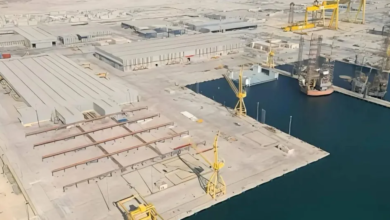
Desalination plants in the Gulf: Vital infrastructure under a protective umbrella

A British report indicated that military tensions in the region have brought back into focus the importance of desalination plants in the Gulf states as one of the most vital facilities upon which daily life and economic activities are based.
The report noted that some security assessments place these facilities among the sensitive infrastructure that countries are keen to protect and enhance their security, given that Gulf cities rely heavily on seawater desalination to provide potable water and water for various uses.
Desalination: The lifeblood of the Gulf
The Gulf Cooperation Council (GCC) countries rely heavily on seawater desalination to provide potable water for drinking and daily use. Data indicates that Kuwait depends on desalination for approximately 90% of its drinking water, while the figure is 86% in Oman and around 70% in Saudi Arabia, making these vital facilities a cornerstone of stability in daily life and the region's economy.
The Gulf: A global water power
The Associated Press quoted Michael Christopher Lowe, director of the Middle East Center at the University of Utah, as saying that the Gulf states, despite their reputation as major oil powers, have also become a "water superpower" thanks to their massive investments in water desalination.
He explained that this achievement, which was accomplished during the twentieth century, represents a developmental success story, but at the same time it could turn into a strategic weakness if these facilities become a military target.
He added that about half of the world's seawater desalination capacity is concentrated in the Gulf countries, reflecting the large reliance on this technology to secure water.
A worrying attack
Bahrain announced last Sunday that an Iranian attack damaged one of its water desalination plants, in a development that raised renewed fears of these sensitive facilities being targeted.
Gulf states and their allies have warned in recent years that targeting desalination plants could threaten regional stability and create widespread humanitarian crises in a region that relies on these facilities for water.
A precedent in the Gulf War
Regional security experts recall a previous experience when Iraqi army forces under Saddam Hussein targeted a number of power and desalination plants after their withdrawal from Kuwait in 1991, in a move aimed at paralyzing vital infrastructure.
Double-edged sword
However, observers believe that Iran cannot go too far in this direction, as some of its coastal regions also rely on seawater desalination to meet their water needs.
Tehran accused the United States last Saturday of carrying out an airstrike targeting a desalination plant on Qeshm Island in the Strait of Hormuz, according to Iranian Foreign Minister Abbas Araqchi, reflecting the sensitivity of this vital sector for all parties.