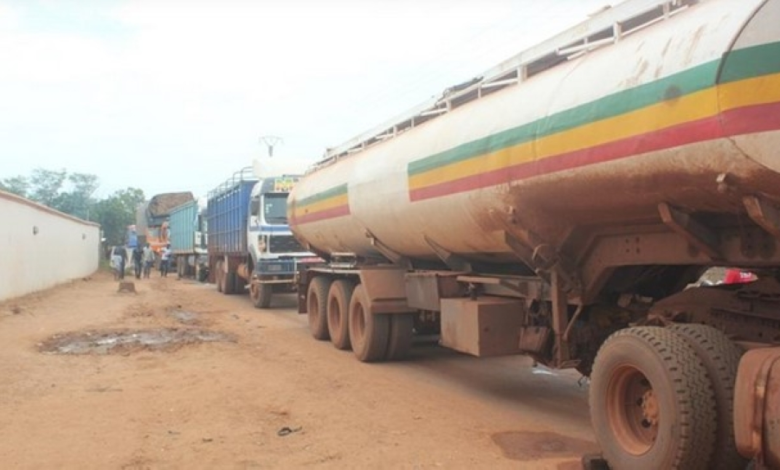

In a serious escalation of violence that threatens Mali's economic lifeline, at least 15 drivers were killed on Thursday in a horrific attack targeting a fuel tanker convoy in the west of the country. Local and security sources told AFP on Monday that the attack was attributed to members of the al-Qaeda-linked group Jama'at Nusrat al-Islam wal-Muslimin (JNIM), indicating a significant shift in the armed groups' strategy to include directly targeting commercial and civilian infrastructure.
Details of the horrific massacre
The deadly attack occurred on the strategic road linking the Senegalese border to the city of Kayes in western Mali. According to a security source who requested anonymity, the gunmen ambushed the convoy, blindfolded the drivers, and then executed them by shooting them at point-blank range, in a scene that underscored the brutality of the attack. A local radio worker, citing a regional official, confirmed that 15 bodies of drivers were found near the burning tankers.
Targeting Mali's economic lifeline
This attack is particularly significant given its geographical location; the city of Kayes and the road leading to Senegal are the main economic arteries of landlocked Mali. Mali relies heavily on the port of Dakar in Senegal for imports of goods and fuel. Analysts suggest that shifting the attacks to this western region, which was considered relatively safe compared to the north and center, aims to economically strangle the capital, Bamako, and impose an undeclared blockade on the flow of essential resources.
Background of the conflict and the spread of violence
Mali has been suffering from a deep security and political crisis since 2012, which began with a rebellion in the north and then escalated into a conflict with armed jihadist groups. Despite previous international military interventions, including those by French forces and the UN peacekeeping mission (MINUSMA), which recently withdrew at the request of the ruling military junta, the violence has continued to spread. The Jama'at Nusrat al-Islam wal-Muslimin (JNIM) group is increasingly active, exploiting the security vacuum in some areas to carry out sophisticated attacks.
A shift in the strategy of armed groups
This incident marks the first time truck drivers have been directly and systematically targeted and killed en masse, although drivers have been killed in previous sporadic attacks. This act follows earlier threats issued by the group last November, when they announced in a video that all fuel truck drivers would be considered legitimate "military targets," in an attempt to disrupt the supply chains of the Malian army and government.
Drivers' demands and the situation on the ground
In the aftermath of the attack, anger and fear gripped drivers and transport companies. During a meeting held on Sunday with Malian authorities, drivers' representatives demanded the immediate intervention of the army to retrieve the bodies still lying at the attack site and secure the road. For its part, the armed group issued a statement, seen by AFP, claiming responsibility for ambushing the Malian army in the same area between Dibouli and Kayes, without explicitly mentioning the killing of the tanker drivers, further complicating the already tense situation.