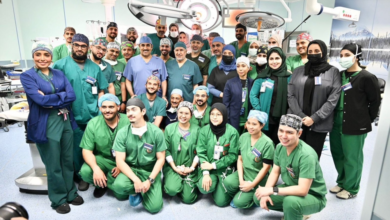
The medical and surgical team at King Abdullah Specialized Children's Hospital in King Abdulaziz Medical City, Ministry of National Guard, Riyadh, has begun conducting thorough medical examinations of the Somali conjoined twins, Rahma and Ramla, in preparation for the complex separation surgery. This step comes in implementation of the directives of the wise leadership of the Kingdom of Saudi Arabia, which has consistently supported such humanitarian cases from around the world, reflecting the Kingdom's leading role in humanitarian and medical work.
The medical team, led by His Excellency Dr. Abdullah bin Abdulaziz Al-Rabeeah, Advisor at the Royal Court, Supervisor General of the King Salman Humanitarian Aid and Relief Center, and head of the medical team, is currently studying the twins' case from all angles. Preparations include a series of laboratory tests, detailed radiological imaging, and intensive meetings among consultants in anesthesia, pediatric surgery, plastic surgery, neurology, orthopedics, and other supporting specialties to ensure the highest safety standards and determine the optimal surgical plan that will guarantee the operation's success, God willing.
The Saudi Program for Separating Conjoined Twins: A Global Leadership
The case of Rahma and Ramla is not an isolated incident, but rather another chapter in the golden chain of successes achieved by the Saudi Program for Separating Conjoined Twins. This program boasts a distinguished track record spanning decades, enabling the Kingdom to attain a prestigious global standing in this delicate medical field. The program has reviewed hundreds of cases from dozens of countries worldwide and performed scores of successful surgeries, achieving record-breaking success rates compared to global averages, thus establishing Riyadh as a trusted medical destination for the most complex cases.
Human dimensions that transcend borders
This event carries dimensions that extend beyond the medical realm; it reinforces the Kingdom of Saudi Arabia's message as a "Kingdom of Humanity." Receiving twins from brotherly and friendly nations, such as Somalia, reflects the depth of fraternal ties and the Kingdom's commitment to extending a helping hand to those in need, regardless of race or nationality. This medical intervention is part of a comprehensive system of aid provided by the King Salman Humanitarian Aid and Relief Center, which works to alleviate human suffering across the globe.
Medical expertise and advanced technologies
These procedures are performed at King Abdulaziz Medical City, a medical facility comparable to leading international centers, equipped with the latest medical technologies and highly qualified Saudi personnel. The success of these operations contributes to enhancing the standing of the Saudi healthcare sector, aligning with the goals of the Kingdom's Vision 2030, which prioritizes the healthcare sector and strives to make it a model of efficiency, quality, and innovation.
As the tests for the twins “Rahma and Ramla” continue, all eyes are on the matter with optimism and prayers for the success of this humanitarian mission, to add to the Kingdom’s shining record in the medicine and surgery of separating twins, and to restore hope to the twins’ family for a normal and independent life for their two daughters.