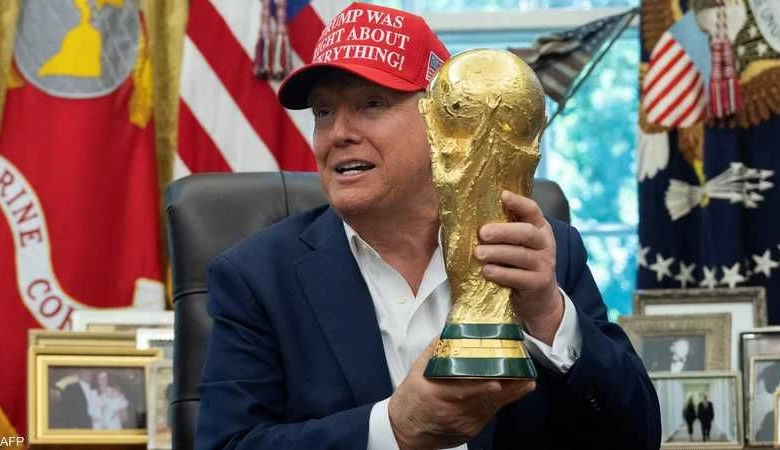

With the countdown to the 2026 World Cup finals nearing its end, political uncertainty and tension hang over the Iranian national team's participation in the tournament, which will be co-hosted by the United States, Canada, and Mexico. These doubts arise approximately 99 days before kickoff, amidst an unprecedented escalation of geopolitical tensions between Tehran on one side, and Tel Aviv and Washington on the other, once again placing sports at the center of the political storm.
Trump's fiery rhetoric and disregard for sports diplomacy
In a striking development reflecting the deep rift between the two countries, US President Donald Trump expressed his indifference to the possibility of the Iranian national team's absence from the World Cup. In an interview with Politico, Trump broke with diplomatic protocol in sports, stating, "I don't really care if Iran participates. I think Iran is a very defeated country, and they are on the verge of collapse." These remarks not only reflect a personal opinion but also clearly indicate that the US administration may not welcome the Iranian delegation on its soil, further complicating the logistical and security situation for the tournament.
A history of football and political tension
This is not the first time that politics and football have intersected between the United States and Iran. History recalls the 1998 World Cup match in France, dubbed the "Mother of All Matches" and imbued with enormous political dimensions, as well as their encounter in the 2022 Qatar World Cup. However, the key difference in the 2026 edition lies in the fact that the United States is the host country, granting American authorities greater influence regarding visa issuance and security arrangements, which is a source of concern for officials in Tehran.
Tehran paves the way for withdrawal or exclusion
From the Iranian side, the tone was decidedly pessimistic. Mehdi Taj, head of the Iranian Football Federation, hinted that the current circumstances might prevent his country's participation. The Associated Press quoted Taj as saying, "What is certain is that after this attack, we cannot expect to look forward to the World Cup with hope." This statement reflects an Iranian awareness that the current military and political escalation could have punitive consequences for the sports sector, or make the national team's travel and security virtually impossible.
FIFA's stance: Neutrality amidst the storm
In an effort to keep football separate from conflicts, FIFA has adopted a cautious approach. Secretary General Mattias Grafström stated that it was still too early to go into details, emphasizing, "We will monitor developments regarding all issues worldwide." Grafström stressed that FIFA's top priority is "ensuring the safety of everyone during the World Cup." FIFA faces a difficult test of its principles of non-interference in politics, especially given past instances of teams being excluded for reasons related to international peace and security.
Group Seven: Football clashes up in the wind
Technically, the draw held in Washington placed Iran in Group G, a tough group that includes Belgium, Egypt, and New Zealand. The presence of a team of Egypt's caliber and a strong European side like Belgium makes Iran's absence a significant blow to the group, as football fans anticipate exciting matches between the stars of these teams. However, the fate of these matches remains uncertain, pending political developments in the coming weeks that could potentially reshape the tournament.