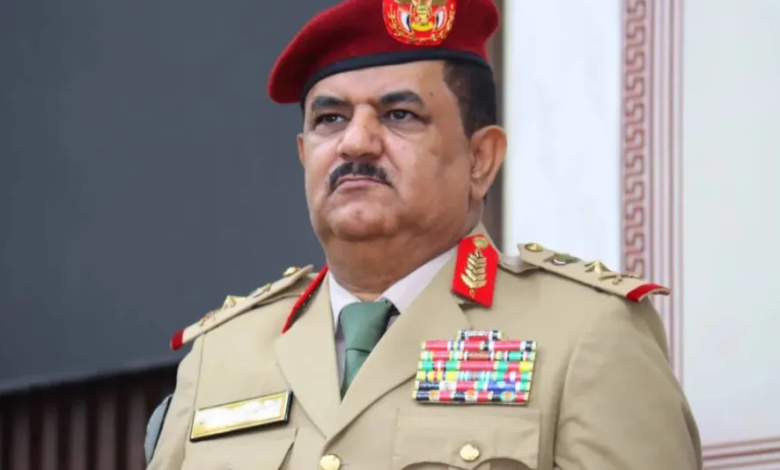

The President of the Presidential Leadership Council in Yemen, Dr. Rashad Al-Alimi, issued important presidential decrees that included ministerial changes in sovereign portfolios, most notably the dismissal of the former Minister of Defense and the appointment of a new leadership for the ministry, in a move aimed at reorganizing the internal structure of the Yemeni military establishment.
Details of the presidential decree and military changes
These decisions came as part of the Presidential Leadership Council's efforts to strengthen the performance of the legitimate government and unify ranks to confront current challenges. The decision stipulated the appointment of Lieutenant General Mohsen al-Daari as Minister of Defense, succeeding Lieutenant General Mohammed Ali al-Maqdashi, who was appointed Advisor to the President of the Presidential Leadership Council for Defense and Security Affairs. This move is part of a package of measures aimed at revitalizing the military establishment, which has been embroiled in a bitter conflict for years.
General context and political background
These changes come at a highly sensitive time for Yemen, particularly following the formation of the Presidential Leadership Council, which assumed power with the aim of unifying anti-Houthi forces. The Yemeni military has suffered from structural divisions and logistical challenges in recent years, impacting the conduct of field operations. Therefore, the decision to change the Minister of Defense is seen as a pivotal step within the framework of the Riyadh consultations and the efforts to integrate the various military formations under the Ministries of Defense and Interior, a key provision of the power transfer agreement.
The importance of the event and its expected impact
This change has broad implications at the local and regional levels:
- Domestically, the decision aims to end the disparity between the various military factions (the National Army, the Giants Brigades, and the Southern Transitional Council formations) and unify the decision-making process regarding war and peace. Having a consensus figure and a professional military leader at the head of the Ministry of Defense would enhance field coordination and improve combat readiness.
- Regionally: The decision reflects the consensus among the parties supporting Yemeni legitimacy, specifically the Arab coalition led by the Kingdom of Saudi Arabia and the United Arab Emirates, on the need to reform the military establishment to ensure the stability of the liberated areas.
- Internationally: The Presidential Council is sending a message to the international community about the government’s seriousness in carrying out structural reforms, which strengthens its diplomatic position in any future peace negotiations or in the event of renewed full-scale military confrontations.
In conclusion, this change in the hierarchy of the Ministry of Defense represents a turning point that may shape the next phase in Yemen, whether through strengthening the military position of the legitimate government to impose peace, or preparing for decisive rounds of conflict to restore the state.