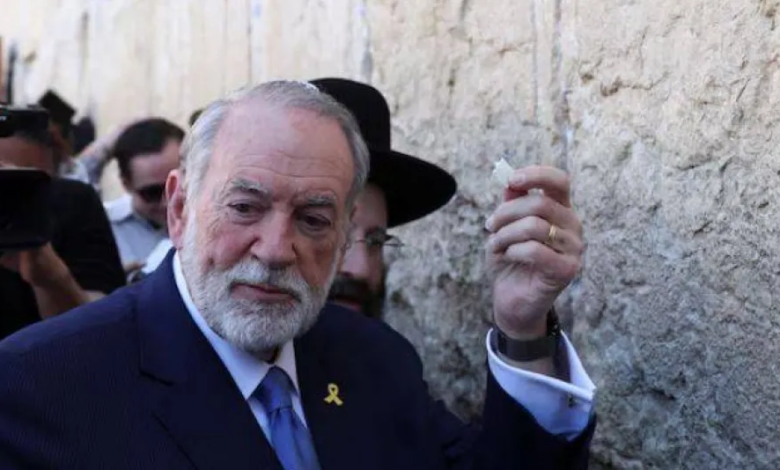
President-elect Donald Trump's announcement of his nomination of former Arkansas Governor Mike Huckabee as the next US ambassador to Israel has sparked widespread anger in Arab and Palestinian circles. This growing resentment stems from Huckabee's well-known ideological positions, characterized by unwavering support for settlement projects and the so-called "Greater Israel" project, which observers and activists consider a form of "colonial rhetoric" that threatens to destroy any remaining prospects for peace in the region.
Huckabee, a former Baptist minister, is known for his staunch refusal to use the term "West Bank," preferring the biblical designations "Judea and Samaria." He has also repeatedly stated that "there is no such thing as occupation" in the Palestinian territories. These positions have raised serious concerns that his tenure could constitute a green light from the United States for the Israeli right-wing government to proceed with its plans to annex the occupied West Bank, effectively eliminating the two-state solution, which represents the cornerstone of the international consensus for resolving the conflict.
Historical background and hardline stances
Mike Huckabee is not a new face on the Middle East political scene; for years he has been a frequent visitor to Israeli settlements and has expressed his unconditional support for their expansion. In previous statements that sparked widespread controversy, Huckabee denied the existence of the Palestinian people as an independent political entity, considering the Palestinian issue a general Arab issue rather than one specific to a particular territory. This ideological background makes his appointment as ambassador a radical shift in American diplomacy, which has traditionally maintained—at least ostensibly—a certain distance from the extreme pro-settlement movement.
Potential regional and international repercussions
Political analysts believe this appointment carries serious implications that go beyond a mere change of names; it reflects a new American direction that could lead to a diplomatic clash with Arab states, particularly those that have peace treaties with Israel or are engaged in the normalization process. Washington's adoption of the "Greater Israel" narrative through its ambassador could embarrass Arab allies and inflame public opinion in the Arab and Muslim world, thus complicating efforts to de-escalate tensions in Gaza, Lebanon, and the region as a whole.
Internationally, this approach could lead to greater isolation for the United States and Israel in international forums, where international law considers the settlements illegal. Transforming the US embassy into a platform for defending annexation and settlement activity could put Washington on a direct collision course with the United Nations and the European Union, which maintain that a two-state solution is the only way to end the conflict.
An uncertain future for the peace process
Given these circumstances, there is widespread pessimism regarding the future of any political process in the region. With an ambassador who denies the existence of the occupation and openly supports full Israeli sovereignty over Palestinian territories, it appears that the incoming US administration may be inclined to manage the conflict according to the vision of the Israeli right wing rather than resolve it. This new reality presents the Palestinian leadership and Arab states with unprecedented challenges in formulating a unified strategy to confront the dangers of the final liquidation of the Palestinian cause.