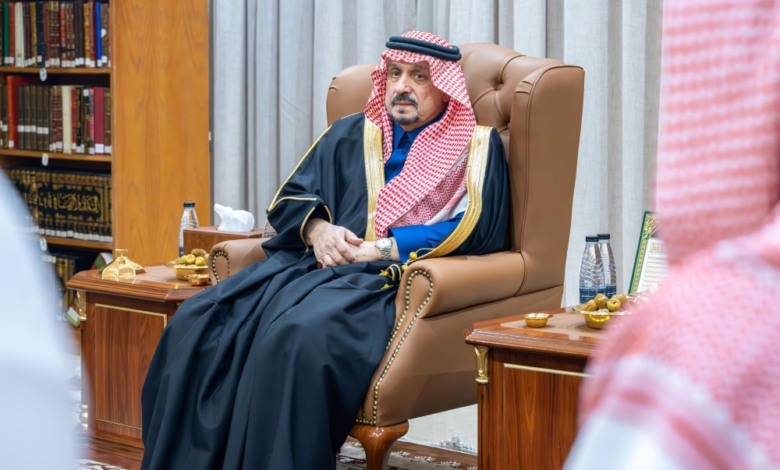
The Governor of Riyadh visits Sheikh Saleh Al-Fawzan: Details of the fraternal meeting

As part of the ongoing communication between the leadership and scholars, His Royal Highness Prince Faisal bin Bandar bin Abdulaziz, Governor of Riyadh Region, paid a gracious visit today to His Eminence Sheikh Dr. Saleh bin Fawzan Al-Fawzan, member of the Council of Senior Scholars and member of the Permanent Committee for Islamic Rulings, at his home in Riyadh. This visit was to check on the Sheikh's health and exchange friendly conversation, reflecting the deep fraternal ties and the great esteem in which the wise leadership holds scholars.
Details of the fraternal visit
During the visit, His Excellency Sheikh Saleh Al-Fawzan welcomed His Royal Highness the Prince of Riyadh, expressing his appreciation for this gracious gesture, which is characteristic of the rulers of this blessed land. The two exchanged cordial greetings, with Sheikh Al-Fawzan commending the tireless efforts of His Royal Highness Prince Faisal bin Bandar in serving and developing the Riyadh region. He prayed to God Almighty to protect the Custodian of the Two Holy Mosques and His Crown Prince, and to perpetuate the blessings of security, safety, and stability upon the Kingdom.
A well-established Saudi approach to valuing scholars
This visit is not a fleeting event, but rather an extension of a long-standing historical approach adopted by the Saudi state since its founding, based on respecting scholars and giving them their due status. The relationship between the royal family and scholars in Saudi Arabia is characterized by strength and integration, with the rulers always keen to visit scholars in their gatherings and homes, consult with them, and check on their well-being. This approach strengthens national unity and affirms the Islamic identity of the state, which takes the Quran and Sunnah as its constitution and guiding principles.
The importance of communication and its societal impact
Such visits carry profound significance and send important messages both domestically and internationally, affirming the stability of the internal front and the strength of Saudi society. The appearance of officials alongside prominent scholars also sends reassuring messages to the community and thwarts any attempts to undermine national principles. Sheikh Saleh Al-Fawzan is a towering scholar with significant contributions to jurisprudence and theology, and his works are studied in various Islamic universities. This makes his visit by the Governor of Riyadh highly positive within academic and social circles.
At the conclusion of the visit, Sheikh Al-Fawzan renewed his prayers for His Highness the Prince’s success and guidance in his practical duties, stressing that the unity of the ruler, the ruled, and the scholars is the safety valve for this country against all challenges.