Argentina's withdrawal from the World Health Organization: reasons and consequences

A geopolitical development deepens the health governance crisis
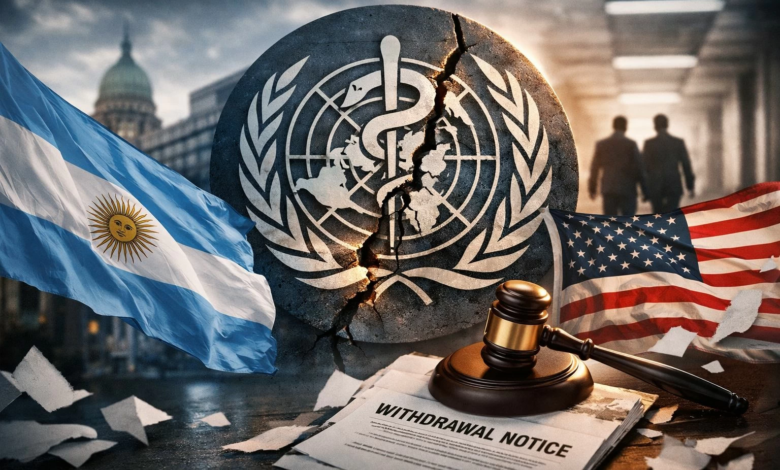
In a geopolitical development that deepens the debate surrounding the future of international health governance, Argentina's decision to withdraw from the World Health Organization has officially taken effect. This makes it the second country, after the United States, to pursue this isolationist path in such a short period. The move reflects a marked rise in sovereignism in managing national health affairs and presents the international organization with a highly sensitive political and financial test at a time when the world is facing unprecedented health challenges.
General context and historical background of the event
The World Health Organization (WHO) was founded in 1948 as the leading agency coordinating global health efforts and has played crucial roles in eradicating serious diseases and combating global pandemics. However, in recent years, the organization has faced increasing criticism regarding its transparency and responsiveness. Argentina's withdrawal comes amidst a new political trend in Buenos Aires that rejects international intervention and is highly critical of multilateral organizations. This event does not appear to be isolated, but rather part of a broader international context, as the United States has already taken a similar step scheduled to take effect in early 2026, further increasing pressure on the organization and reviving past tensions between Washington and UN institutions.
The sovereignty of the health decision and the available alternatives
The Argentine Foreign Minister affirmed that his country is proceeding with reshaping its relationship with international health cooperation in a way that preserves its national sovereignty. He indicated that Buenos Aires will continue to work with its partners through bilateral and regional channels, rather than adhering to traditional institutional frameworks. This approach reflects a broader shift among some countries that are increasingly viewing international partnerships through a lens more closely tied to national sovereignty and less committed to multilateral systems, particularly in light of global discussions surrounding the "pandemic treaty," which some capitals perceive as an infringement on their domestic policies.
Financial and operational implications for the organization
The repercussions of these withdrawals are not limited to the political sphere; they extend to create a financial and operational crisis. The World Health Organization relies heavily on contributions from its member states. Historically, the United States has been one of the organization's largest funders, making its departure, along with that of a country as politically and economically significant as Argentina in Latin America, a double challenge to the organization's ability to continue its programs effectively, particularly in developing countries that depend on the organization's support for providing vaccines and combating endemic diseases.
The importance of the event and its expected impact (locally, regionally and internationally)
Domestically , Argentina will have to build a new network of health alliances to ensure its pharmaceutical and epidemiological security outside the WHO umbrella. Regionally , this decision may encourage other Latin American countries to reconsider their commitments to the Pan American Health Organization (PAHO) and the World Health Organization. Internationally in a unified manner to health emergencies.
A test for the future of international cooperation
The question today is no longer simply the withdrawal of two countries, but whether the world is witnessing the beginning of a gradual decline in trust in multilateral organizations, or whether we are on the cusp of a new model of international cooperation based on more flexible partnerships and less adherence to traditional frameworks. Between calls for health sovereignty and the urgent need for global, cross-border coordination, the World Health Organization stands at a pivotal moment that may force it to review its role and mechanisms, and perhaps even reinvent itself to keep pace with a rapidly changing world and the rise of nationalism.