The demolition of a Chinese monument in the Panama Canal sparks diplomatic tension

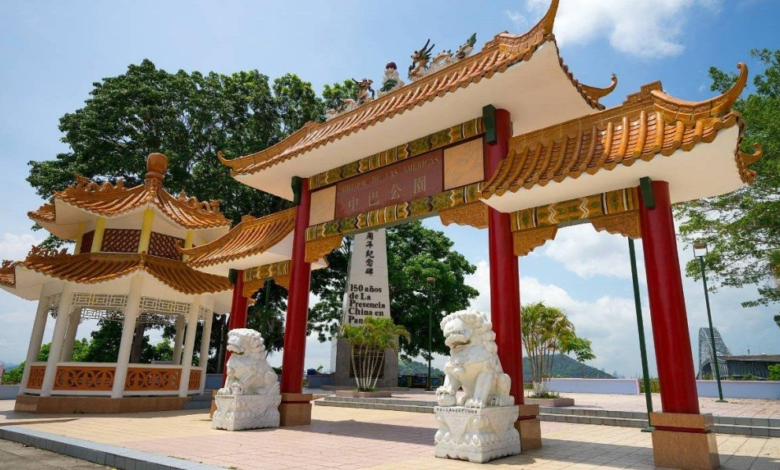
Diplomatic relations in Central America have been suddenly strained following the demolition of a Chinese monument located at the eastern entrance to the strategic Panama Canal, an event described by the Panamanian president as a "barbaric act," at a time when geopolitical tensions between the United States and China over influence in this vital waterway are escalating.
Details of the incident and local justifications
The municipality of Araichan, located at the canal's entrance, issued a surprise order to demolish a traditional Chinese gate erected on the Bridge of the Americas, the massive metal structure spanning the canal. In an official statement, the municipality justified its decision by claiming that the monument, built in 2004 and symbolizing Sino-Panama friendship, had suffered significant structural damage that posed a risk to public safety, thus necessitating its removal.
Presidential anger and Chinese discontent
The incident did not go unnoticed. Panamanian President José Raúl Molino strongly condemned the act, calling it an "unjustifiable barbaric act" and an "unforgivable act of irrationality." He ordered an immediate investigation into the destruction of the monument, which also included two lion statues and an obelisk that still stood. For her part, Chinese Ambassador to Panama Xu Xueyuan expressed her deep regret, describing the day of the demolition as a "dark day" for the approximately 300,000-strong Chinese-Panamanian community. She affirmed that history would record this attack on a symbol of friendship between the two countries.
The historical roots of the Chinese presence in Panama
To understand the depth of Chinese resentment, one must consider the historical context. The Chinese presence in Panama is not a recent phenomenon, but rather dates back to the mid-19th century. Chinese laborers played a pivotal and historic role in the construction of the Panama Railway (the first transcontinental railway) and later participated in the excavation of the Panama Canal. This monument is a tribute to those sacrifices and to these enduring ties, making its demolition an attack on a profound cultural and historical legacy, not merely the removal of an architectural structure.
Geopolitical conflict: Washington and Beijing
This incident comes at a highly sensitive time, as the United States seeks to curb China's growing influence in Latin America. US President Donald Trump has previously threatened to reassert control over the Panama Canal, expressing concern over the Hong Kong-based company Hutchison Holdings' management of two strategic ports on either side of the canal. Washington fears that China's commercial influence could translate into strategic influence, threatening US national security in its own backyard.
The strategic importance of the Panama Canal
The Panama Canal is a vital artery for global trade, handling approximately 5% of international maritime commerce. The United States and China are the largest users of this 80-kilometer-long waterway. The canal was under complete U.S. control from its opening in 1914 until its transfer to Panama at the end of 1999, making any shift in the balance of power surrounding it a matter of national security for Washington and a vital influence issue for Beijing.