
The Southern Transitional Council's escalation threatens the unity of the Yemeni Presidential Leadership Council

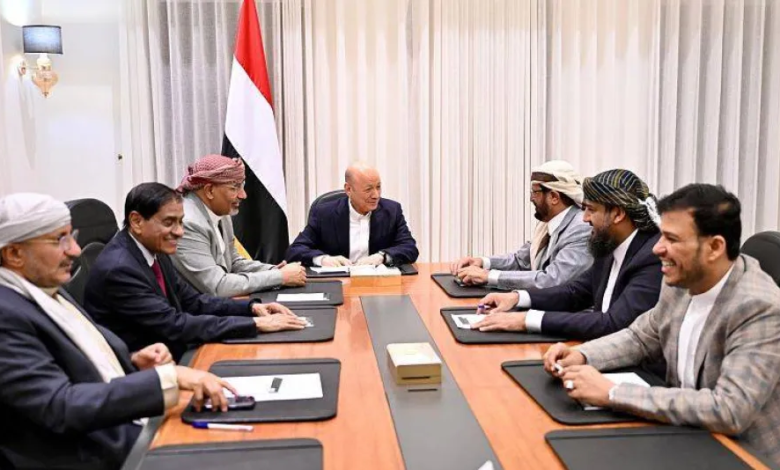
The Yemeni political landscape is facing a new critical juncture, as the Southern Transitional Council's the Presidential Leadership Council to a real test of its "unity of decision-making." These developments highlight the fragility of political consensus within the anti-Houthi camp and raise serious questions about the future of the power-sharing arrangement within the internationally recognized legitimate government.
Historical background: Formation of the Presidential Leadership Council
the Presidential Leadership Council was formed in the Saudi capital, Riyadh, following the announcement of the transfer of power from former President Abd Rabbuh Mansur Hadi. The primary objective of this formation was to unify the various military and political factions opposed to the Houthi movement under a single umbrella. The council included leaders with differing orientations, most notably Aidarus al-Zubaidi, head of the Southern Transitional Council, which advocates a political project aimed at restoring the pre-1990 state of South Yemen.
Roots of the dispute and challenges of the partnership
Despite the apparent agreement to confront the Houthi expansion, the divergence in strategic objectives among the components of the Presidential Council remains a ticking time bomb. The Southern Transitional Council views its partnership in the Presidential Council as a tactical phase that does not negate its strategic goal of "secession," a position that clashes with the national agenda of the other components, which seek to preserve Yemeni unity and restore the state in Sana'a. This fundamental contradiction makes "unified decision-making" within the Council a daunting task, as political and military decisions and administrative appointments often clash with calculations of power-sharing and regional influence.
Political and economic repercussions
Any escalation by the Southern Transitional Council, whether military in the southern governorates or political through media statements, casts a dark shadow on the overall situation in Yemen:
- On the economic front: Political instability in the interim capital Aden is leading to a deterioration in the exchange rate of the local currency, capital flight, and disruption of government efforts to improve basic services, exacerbating the humanitarian suffering of citizens.
- On the military level: This dispute is delaying the integration of military and security formations under the Ministries of Defense and Interior, which is one of the most important clauses of the Riyadh Agreement and the consultations on the transfer of power, thus keeping the security situation fragile and prone to explosion.
- On the international level: The internal division weakens the legitimate government’s position before the international community and the UN envoy, and gives the Houthi group an opportunity to strengthen its negotiating position or exploit military gaps.
The future of the leadership council amidst the power struggles
The future of the Presidential Leadership Council remains contingent on the ability of regional sponsors, particularly Saudi Arabia and the United Arab Emirates, to contain these disagreements and coordinate the divergent actions. The current test of "unity of decision-making" is not merely a passing crisis, but rather an indicator of the viability of this hybrid alliance in the absence of a unified political vision for Yemen's future. This leaves all scenarios open, ranging from a restructuring of alliances to a prolonged political stalemate.