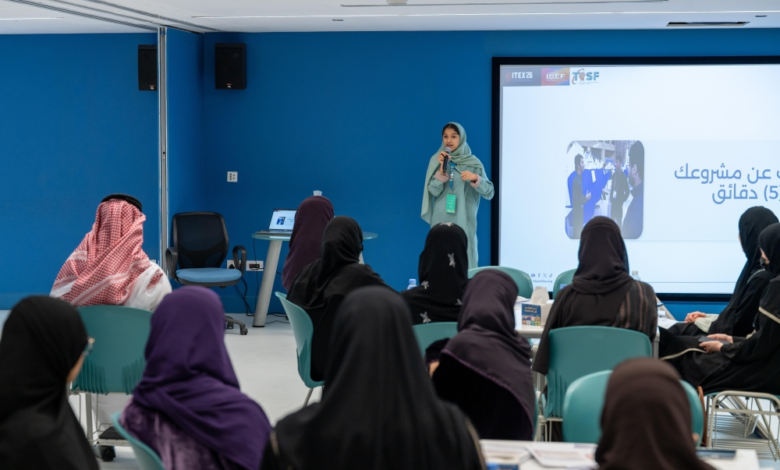
Mawhiba launches the training program for the Creativity 2026 international competitions

In a strategic move reflecting the Kingdom of Saudi Arabia’s commitment to supporting innovation and empowering young minds, the King Abdulaziz and His Companions Foundation for Giftedness and Creativity (Mawhiba), in strategic partnership with the Ministry of Education, launched the “International Participation Qualification Program.” This intensive program aims to prepare and equip a select group of talented students who excelled in the National Olympiad for Scientific Creativity to represent the Kingdom in upcoming international scientific events.
Training camp in “Mishkat” to create future leaders
The program's activities began at the Mishkat Interactive Center in the King Abdullah City for Atomic and Renewable Energy in Riyadh and will continue until February 14. The camp includes 66 talented young people (28 male and 38 female students) who won major awards at the "Ibdaa 2026" exhibition.
Participants undergo a rigorous and comprehensive training program, during which a select group of mentors and academic experts meticulously review scientific projects and develop individualized development plans for each project to enhance its research quality and scientific methodology. The program also includes specialized workshops in presentation skills, enabling students to confidently and professionally present their innovations to international judging panels. Additionally, there are sessions dedicated to introducing international judging mechanisms and reviewing the scientific ethics committee's guidelines to ensure the safety of experiments and their compliance with international standards.
A roadmap towards global podium finishes
This program is the sixth and final stage of the National Olympiad for Scientific Creativity, and it serves as the main gateway for students from the Kingdom to the international arena. These students are prepared to compete in the most important scientific competitions worldwide, including:
- Regeneron International Science and Engineering Fair “ISEF 2026” in the United States of America.
- The International Exhibition of Inventions, Innovations and Technology “ITEX 2026” in Malaysia.
- Taiwan International Science Fair “TAISF 2027”.
These participations are of utmost importance, as they represent the highest levels of scientific competition for public education students, and provide a platform to showcase Saudi capabilities in the fields of science, engineering and technology.
A distinguished record and historic achievements
This program comes as a continuation of the impressive track record of achievements attained by Mawhiba and the Kingdom's students in recent years. The Kingdom has successfully established itself as a rising scientific power, ranking second globally after the United States at the International Science and Engineering Fair (ISEF), an achievement that reflects the efficiency of the Kingdom's educational system and programs for nurturing gifted students.
In a related development, Mawhiba achieved an unprecedented global milestone by entering the Guinness World Records for its 2026 Creativity Competition, the world's largest competition for innovative solutions. This year's competition saw record participation, with over 357,000 students from across the Kingdom taking part, representing a 22.7% increase compared to the previous year. They submitted more than 34,000 scientific projects, reflecting the expanding pool of talent and the growing culture of scientific research and innovation among young people.
National and strategic impact
The importance of this program is not limited to awards and medals, but extends to building a generation of scientists and researchers capable of contributing to achieving the goals of the Kingdom’s Vision 2030. By investing in these young minds, the Kingdom seeks to move towards a knowledge-based economy and find innovative solutions to developmental and industrial challenges, which enhances the Kingdom’s competitiveness and leading position on the international map.