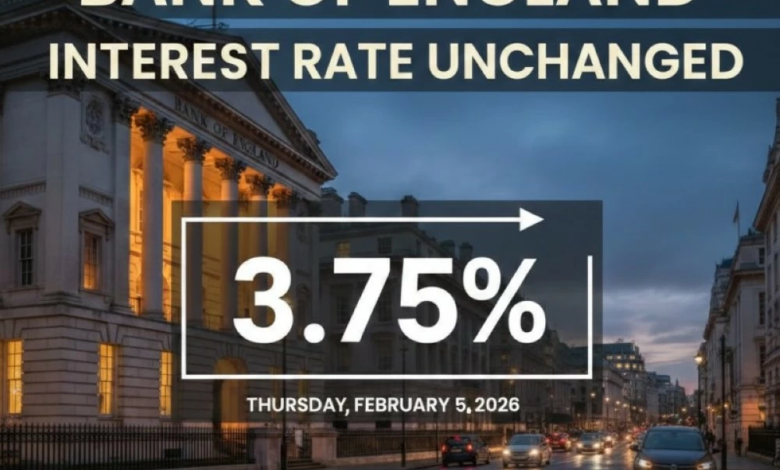

In a move largely in line with financial market expectations, the Bank of England decided to keep its main interest rate unchanged at 3.75%. This decision comes at a time when the British economy faces the dual challenges of inflation rates that remain above the official target and mixed indicators of economic growth.
Sharp division within the Monetary Policy Committee
The voting results revealed a clear division among members of the central bank's Monetary Policy Committee, reflecting the challenging economic landscape. Five members in favor of maintaining the current rate, preferring to wait and see more economic data, while four for an immediate interest rate cut. This close vote suggests that the bank may be very close to changing its monetary policy at upcoming meetings if economic data continues to support such a course.
Market reaction and decline of the British pound
Immediately after the announcement, currency markets reacted swiftly, with the British pound falling against the US dollar. The pound dropped 0.6% , from 1.3610 to 1.3550 against the dollar. Analysts attribute this decline partly to the disappointment of some investors who had been betting on a surprise interest rate cut, as well as the Bank's cautious outlook on growth.
Growth and inflation forecasts: A cautious outlook
In its assessment of economic performance, the Bank of England revised its UK economic growth forecasts for 2026 and 2027 downward, according to Agence France-Presse. Although the economy showed signs of recovery and a stronger-than-expected start to the year, the Bank remains cautious. Inflation remains at 3.4% , significantly higher than the Bank's target (normally 2%), putting upward pressure on policymakers and preventing them from easing monetary policy further at present.
Historical context and path of interest
This decision to hold rates steady follows a series of interest rate cuts implemented by the central bank over the past 18 months to support the economy. The last cut, a quarter of a percentage point, was implemented last December. The bank had previously indicated the possibility of further cuts this year, but persistently high inflation levels have forced it to pause and assess the cumulative impact of previous policies.
Expected effects
This decision is pivotal for citizens and businesses in Britain; holding interest rates steady means borrowing costs will remain at their current levels for a little longer, impacting the housing, mortgage, and business lending markets. The Bank of England's biggest challenge remains achieving a "soft landing"—that is, curbing inflation to return to the target without stifling the economic growth that has begun to show slight signs of improvement.