The success of semi-automated offside technology in the Brazilian league: Goodbye to mistakes

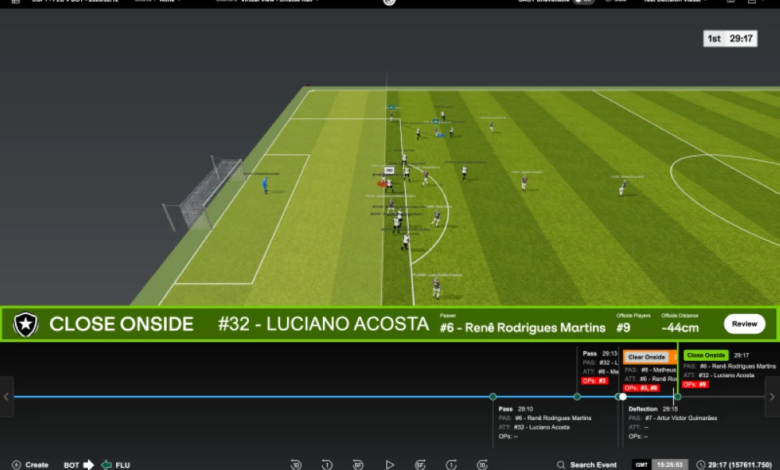
In a historic move aimed at raising the standard of refereeing in Latin American football, the Brazilian Football Confederation (CBF) announced the successful completion of the first phase of testing the semi-automated offside technology (SAOT) . This pioneering trial took place at the iconic Maracanã Stadium, specifically during the fiery derby match between Fluminense and Botafogo on February 12th, as part of the third round of the Brazilian league.
Details of the technical experience in El Clásico
The test results demonstrated exceptional accuracy in refereeing decisions made on the field, with the advanced technology analyzing controversial plays with remarkable speed. This technology, which has already proven its global success at the 2022 World Cup, relies on generating digital images and 3D simulations of players in a manner similar to modern video games, allowing for the precise, millimeter-level positioning of players' limbs the moment the ball leaves a teammate's foot.
The technical report presented real-life examples from the match, most notably a Fluminense attacking move where technology revealed that Rene's right foot was slightly ahead of defender Alex Telles, thus confirming the offside decision. Conversely, the digital data confirmed Luciano Acosta's position, as he benefited from defender Alexandre Barbosa's marking. In both instances, the system's output perfectly matched referee Rafael Klein's decisions, reinforcing confidence in the technology-assisted human expertise.
The global context and the importance of the move for Brazilian football
This move comes within a global context that is moving towards automating refereeing decisions to reduce wasted time and increase fairness in the game. Brazil is among the leading countries in South America to adopt these standards, which are currently implemented in the UEFA Champions League and the top five European leagues. The significance of this event lies not only in the application of new technology but also in representing a qualitative leap for the Brazilian league, enhancing its marketing value and placing it among the world's most organizationally advanced leagues.
Infrastructure and future expansion plans
Neto Gois, head of the refereeing working group at AFC, confirmed that the initial results were very promising, noting that the ultimate goal is to provide referees with tools that ensure optimal decision-making and strengthen the confidence of fans and clubs. He explained that the benefits extend to collecting detailed player performance tracking data, which clubs can utilize technically.
The upgrades are set to continue with the installation of the system at six other major stadiums hosting league matches: Arena do Grêmio, Arena MRV, Allianz Parque, Meão, Arena Fonte Nova, and Vila Belmiro, in addition to further testing at the Maracanã. The Brazilian Football Confederation (CBF) is bearing all the financial costs of this major project, reaffirming its full commitment to developing the game's infrastructure and ensuring the highest levels of transparency and professionalism.