

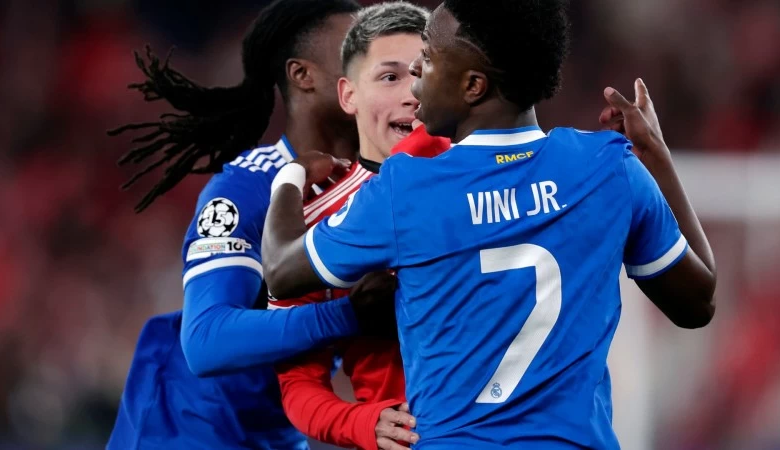
The sporting and political spheres have witnessed a significant escalation over the past three days following the deplorable racist incident targeting Brazilian star Vinicius Junior, a Real Madrid player, during his team's Champions League match against Benfica in Lisbon, Portugal. The repercussions of the incident extended beyond the pitch, prompting high-level diplomatic intervention from the Brazilian government.
strongly worded government statement
In an official move reflecting the seriousness of the situation, the Brazilian government issued a joint statement from the Ministries of Sport and Racial Equality, expressing its full and unconditional solidarity with Vinicius. The statement, published on social media, read: “It is unacceptable for racist incidents to occur in sporting environments, which should be spaces of respect and coexistence.” The two ministries emphasized that racism is not merely verbal abuse, but rather “a violation of human rights and an attack on the fundamental principles of sport,” describing it as a crime that has no statute of limitations.
Activating international protocols and legal follow-up
The government statement, which was circulated by international media outlets such as RT, clarified that Brazil is demanding the strict implementation of the anti-racism protocol adopted by UEFA. The government indicated that it will not be satisfied with mere verbal condemnations, but will closely monitor the progress of the investigations announced by UEFA, anticipating firm punitive measures against those involved to ensure that such offensive incidents are not repeated in the future.
Historical context and ongoing battle
This incident adds another chapter to the ongoing struggles faced by Vinicius Junior in European football, where the player has become a global symbol in the fight against racism in recent years. These cases are no longer isolated incidents, but rather reflect a structural challenge facing global football, prompting Brazil to enact local laws (such as the Vinicius Law) to combat racism in sporting events and to attempt to leverage this experience to pressure international federations.
International dimensions of the event
This government intervention is particularly significant as it shifts the issue from a purely sporting context to a diplomatic and legal one. The Brazilian government's support for its citizen reflects the state's commitment to protecting the dignity of its athletes abroad and places considerable pressure on European sports institutions to demonstrate their commitment to the "no racism" slogan. The government concluded its statement by emphasizing that this is a collective struggle, saying: "This is not just Vinicius's individual battle, but our collective battle to ensure fair, inclusive, and discrimination-free sport.".


