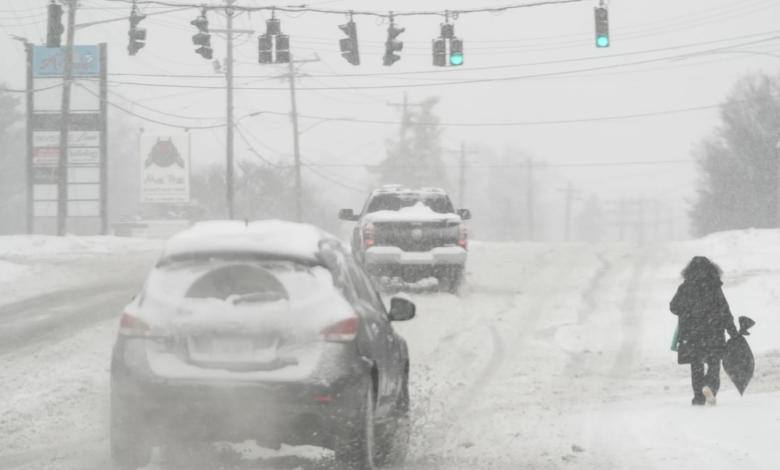
The United States has witnessed a new climate disaster in the form of storm that has killed at least 21 people and caused a complete paralysis of life facilities in several states, leaving more than 800,000 homes without electricity amid record low temperatures.
Details of the climate disaster
Residents of the Great Lakes region and the northern part of the country woke up to a freezing reality, as temperatures plummeted to dangerously low levels of -20 degrees Celsius, and parts of Minnesota and Wisconsin recorded terrifying lows of -30 degrees Celsius, according to data from the National Weather Service.
Forecasts indicate that temperatures will continue to drop in the coming days under the influence of a very cold polar air mass, especially in the central regions of the country, where the wind chill is expected to reach -45 degrees Celsius, posing a real danger to the lives of residents who do not have adequate shelter or heating.
Paralysis in infrastructure and energy
The storm's damage wasn't limited to the bitter cold; heavy snowfall, exceeding 30 centimeters in some 20 states, led to widespread power outages. According to the specialized website PowerOutage, 820,000 customers suffered power cuts, mostly concentrated in the southern United States where infrastructure is ill-equipped to handle such icy conditions that brought down power lines.
In this context, meteorologist Alison Santorelli stated: "Power outages may continue for several more days, while authorities face difficulties in recovering from the storm's effects, as most of these areas do not have the means or resources to remove snow and damage after such unusual events.".
Scientific background: Polar vortex
To understand the nature of this event, scientists point to the phenomenon of the "polar vortex," a massive mass of cold air that typically swirls over the Arctic. When this vortex weakens, it allows frigid air to rush south toward the American continent, causing historic cold waves.
Many climate scientists link the increasing frequency and intensity of these disturbances to the phenomenon of climate change, as the warming of the Arctic leads to instability in the jet stream, allowing polar cold to penetrate areas not accustomed to such conditions, which explains the climate chaos that has recently struck the world.
Human casualties and a state of emergency
The severe conditions prompted authorities to declare a state of emergency in approximately 20 states, in addition to Washington, D.C. Local media reported 21 storm-related deaths, ranging from traffic accidents caused by ice to hypothermia and other incidents.
- Texas: Three people, including a 16-year-old girl, have died.
- Louisiana: Two people died due to the cold.
- New York: Five people found dead in the open, prompting Mayor Zahran Mamdani to warn of the "precarious situation of the homeless population."
Economic impacts and political controversy
The storm cast a heavy shadow over the transportation sector and the economy, as air traffic came to a near standstill at major airports such as Washington, Philadelphia and New York, and more than 19,000 flights were cancelled, causing heavy losses for airlines and passengers.
On the political front, the storm reignited the debate over climate change. President Donald Trump seized on the event to once again cast doubt on global warming, writing on his Truth Social platform: "Can these environmentalists explain to me what happened to warming?"—a statement reflecting the ongoing division over how to address the escalating climate crisis.