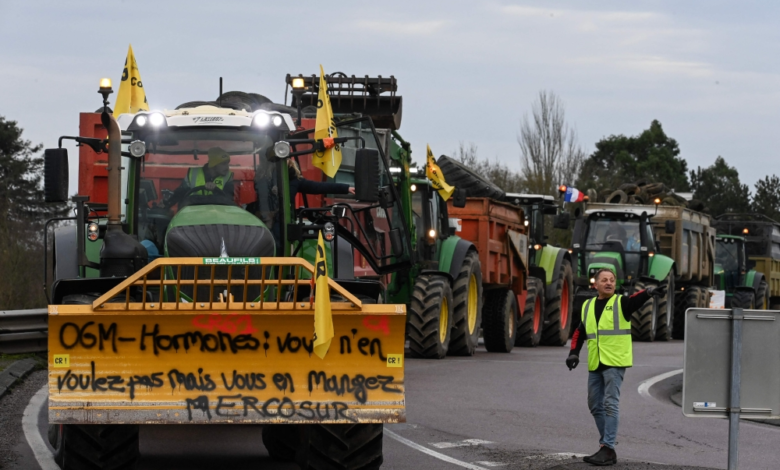
French farmers continued to block several major roads in the southwest of the country on Saturday, in open defiance of the French government's calls for a "truce" during the Christmas period. These protests reflect growing anger over government policies regarding livestock epidemics, particularly the protocols for the systematic slaughter of herds.
Continued mobilization and rejection of temporary solutions
Despite the festive atmosphere prevailing in the country, farmers in the southwest region insisted on making their voices heard by disrupting traffic. Speaking to AFP, Sarah Melki, spokesperson for the Farmers' Confederation (Confédération Paysanne) in the Aveyron region, confirmed that the protests would continue until fundamental solutions were found.
Maliki stated, “As long as there is no real change in health policy, and as long as the government continues its approach of systematically and completely culling entire herds as soon as a single case of contagious lumpy skin disease appears on any farm, we will continue to mobilize.” This statement reflects the desperation of farmers who see the “total culling” policy as an existential threat to their professional and economic future, preferring alternative options such as quarantine or vaccination rather than the complete eradication of their livestock.
Traffic gridlock on main roads
On the ground, the farmers’ union, which is affiliated with the left-wing movement, translated its threats into concrete reality, as it set up a new roadblock on the “A75” motorway linking Clermont-Ferrand and Montpellier, causing it to be completely closed to traffic in the southbound direction for several hours before it was reopened in the afternoon.
Meanwhile, other routes experienced near-total paralysis, with the A64 motorway linking Toulouse and Bayonne remaining closed for over 180 kilometers, causing significant disruption to traffic. The A63 motorway, a vital artery connecting Bordeaux to the Spanish border, also remained closed near Sestas, south of Bordeaux, negatively impacting international freight traffic between the two countries.
Context of the crisis: between economic pressures and health policies
These protests cannot be separated from the broader context of the agricultural sector in France and Europe in general. French farmers have long been suffering from increasing pressures, including rising production costs, fierce competition from imported products, and what they consider unfair and stringent European environmental and health standards.
The livestock epidemic proved to be the final straw, as farmers believe government compensation does not cover the heavy losses resulting from the culling of herds that took years of genetic and breeding work to build. Agricultural unions are demanding greater flexibility in dealing with disease outbreaks to protect public health without destroying the rural economy.
Local and regional impacts
These actions are particularly significant given their timing and location; blocking roads to Spain disrupts food supply chains at a crucial time of year. Furthermore, the ongoing protests are placing the French government under considerable political pressure as it attempts to balance maintaining public order with addressing the demands of a social group with significant electoral and economic influence.
According to data from the French Interior Ministry, 50 protest actions were recorded on Saturday, involving 1,619 people. This figure represents a slight decrease compared to the 93 actions and approximately 4,000 participants on Friday. However, the nature of the actions and their impact on highways still pose a security and economic challenge for the authorities.