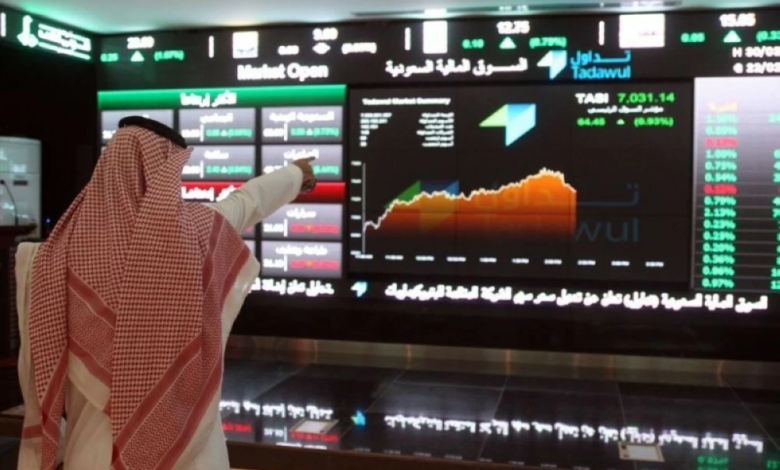
The Saudi Stock Exchange's main index (TASI) ended trading today with a slight decline, falling 34.44 points to settle at 10,290.76 points. Trading volume reached approximately SAR 3.5 billion, reflecting a cautious and watchful stance among market participants.
According to the Saudi Press Agency's daily economic bulletin on the stock market, 191 million shares were traded during the session. Market data showed a clear divergence in the performance of listed companies, with 80 companies recording an increase in their market value, while 178 companies were unable to maintain their gains and closed lower, indicating selling pressure across a wide range of sectors.
Top performing and worst performing companies
In terms of individual company performance, shares of Amac, Electrical Industries, Maaden, Sinomi Retail, and Al Babtain topped the list of gainers. Conversely, shares of Burgerizer, Bahri, National Education, Al-Drees, and SASCO were the biggest losers. The percentage changes for these companies ranged between 7.83% and 8.14%, reflecting significant price volatility during the trading session.
Liquidity and market activity
Regarding stock market activity, the most actively traded stocks by volume were "SADARAT," "Americana," "BATC," and "Saudi Aramco." In terms of trading value, however, the major blue-chip companies dominated, with "Saudi Aramco," "Ma'aden," "Al Rajhi Bank," "stc," and "National Bank" topping the list of most active stocks. This underscores the continued concentration of institutional and buying liquidity in leading, financially sound stocks.
Economic context and market importance
The movements of the Saudi stock market are of particular importance given Tadawul's position as the largest stock exchange in the Middle East and North Africa region. The 10,000-point level is considered a significant psychological and technical barrier for investors. The market is typically influenced by several macroeconomic factors, including global oil prices due to the energy sector's weight in the index, as well as interest rates and global economic data, which affect the risk appetite of both local and foreign investors.
The discrepancy between the number of high and low companies reflects the nature of the current phase, which may be characterized by profit-taking or a rearrangement of the financial positions of investment portfolios, especially in light of the rapid economic developments that the Kingdom is witnessing within Vision 2030, which aims to diversify the economy and enhance the attractiveness of the financial market for foreign investments.
Parallel market performance (growth)
On the other hand, the Saudi parallel market index (Nomu) bucked the trend of the main market, closing 100.66 points higher at 23,327.60 points. Trading volume in the parallel market reached approximately SAR 16 million, with over two million shares traded, indicating promising investment opportunities that attract a specific segment of investors to the small and medium-sized enterprises (SMEs) listed on this market.