Saudi achievement: Manufacturing a nanomaterial in space to repair cartilage

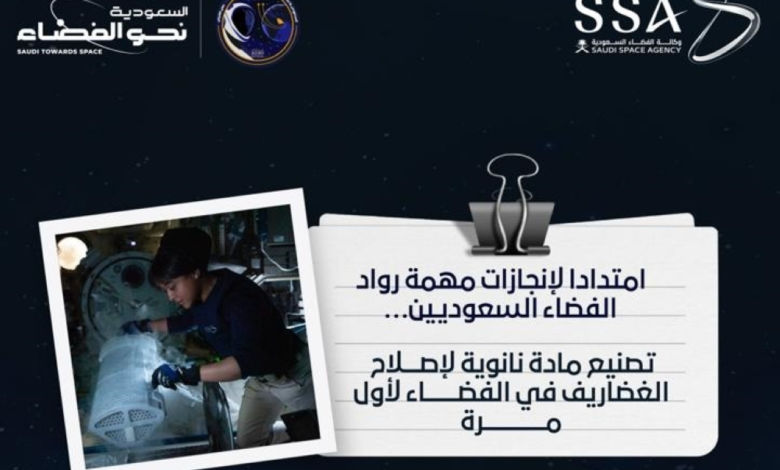
In an unprecedented scientific achievement that reinforces the Kingdom of Saudi Arabia's position in the space sector and scientific research, the Saudi Space Agency the success of a groundbreaking scientific experiment: the first-ever production of a nanomaterial designed for cartilage repair in a microgravity environment (space). This announcement culminates the efforts undertaken during the Kingdom's historic space mission (SSA-HSF1), which saw Saudi astronauts participate in advanced research aboard the International Space Station.
Details of the scientific achievement in the journal Nature
The agency explained that the research findings of this experiment were published in the prestigious journal *Nature*, one of the world's most influential scientific journals. The scientific team was led by Yubing Chen and Mary Ann Snow, in a broad international collaboration, while Saudi astronaut Rayana Barnawi , a research and laboratory specialist, carried out the experiment in space. The experiment focused on developing advanced biomaterials for tissue engineering, and the results demonstrated a significant improvement in the accuracy and quality of the nanomaterial manufactured in space compared to its counterparts manufactured on Earth.
Why manufacture in space?
This experiment derives its significance from the unique properties of the space environment; the microgravity environment provides ideal conditions for material interactions and crystal formation without the sedimentation or thermal currents present on Earth. This stability allows for the production of nanomaterials with a more regular and efficient structure, enhancing their effectiveness in medical applications, particularly in cartilage repair, a major medical challenge due to the difficulty of natural cartilage regeneration.
Context of the historic mission SSA-HSF1
This achievement is part of the outputs of the Kingdom's scientific mission, which launched in May 2023. Saudi astronauts Rayana Barnawi and Ali Al-Qarni conducted 14 pioneering scientific experiments (out of a total of 19 mission experiments) in collaboration with international space agencies and research universities. These experiments covered diverse fields including biomedicine, physics, and astronomy, with the aim of providing sustainable solutions that serve humanity.
Future prospects and Vision 2030
Commenting on the event, Rayana Barnawi said, "Conducting the experiment in space enabled the fabrication of an advanced nanomaterial and the generation of reliable data that supports the development of scientific research contributing to improving human life and serving humanity." These results underscore the commitment of the Kingdom of Saudi Arabia, represented by its Space Agency, to achieving the goals of Vision 2030 , which seeks to localize advanced industries, maximize the economic and scientific returns from the space sector, and transform it into a platform for innovation that contributes to finding advanced medical treatments for chronic diseases.