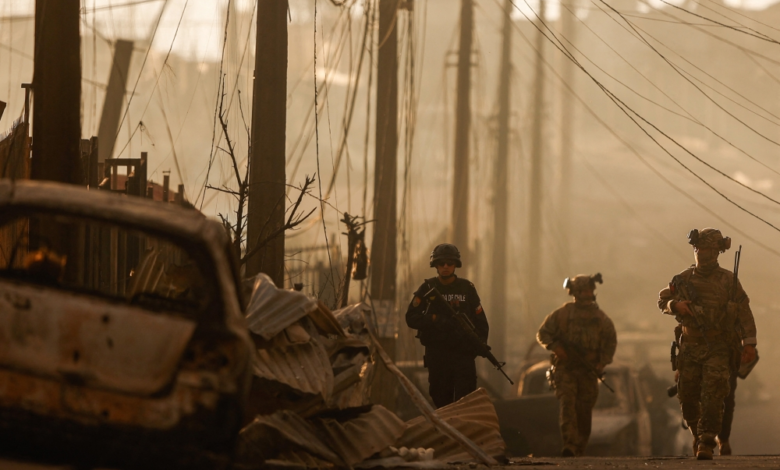

The death toll from the devastating wildfires raging across southern Chile has risen to at least 19, marking another environmental and humanitarian disaster for the country. Chilean authorities announced a nighttime curfew on Sunday in the worst-affected areas in an effort to control the situation and facilitate evacuations and rescue operations that have impacted tens of thousands of residents.
Details of the humanitarian disaster
Chilean Security Minister Luis Cordero confirmed in a press statement that the death toll had reached 19, noting that the vast majority (18 victims) died in the Biobío region, while one death was recorded in the Noble region. These figures follow an earlier announcement by President Gabriel Burrich from Concepción, in which he warned that the number of victims could rise as search and damage assessment operations continued.
As the fires spread rapidly, authorities carried out large-scale evacuations, moving more than 50,000 people to escape the flames that consumed everything in their path. Official reports indicated that 300 homes had been completely destroyed so far, but President Burić clearly stated that "this figure is a significant underestimate," suggesting that the number of destroyed homes would likely exceed 1,000 once the field survey was completed.
Field situation and eyewitness accounts
Fires broke out on Saturday in the provinces of Nuevo and Biobío, about 500 kilometers south of the capital, Santiago. Extreme weather conditions, including temperatures exceeding 30 degrees Celsius and strong winds, turned forests and residential areas into a raging inferno.
In harrowing accounts relayed by AFP, residents described the rapid spread of the fire as "terrifying." "At 2:30 a.m., the fire was completely out of control," said 25-year-old student Matias Seid from the town of Pinco. "If we had been just 20 minutes later, we would be dead." Pinco's mayor, Rodrigo Vera, confirmed that 14 people had died in his town alone, highlighting the scale of the tragedy in the small township.
Climate context and disaster recurrence
These fires are not an isolated event in Chile's recent history; the country faces increasing climate challenges. This particular fire comes in the midst of the southern summer, a period during which Chile has been experiencing a prolonged drought (megadrought) for over a decade, creating ideal conditions for wildfires. Climate change is exacerbating these phenomena, making fire seasons longer and more destructive.
These scenes bring to mind the disaster that struck the country on February 2, 2024, when devastating fires broke out around the city of Viña del Mar and the Valparaíso region, killing 138 people and affecting 16,000, in one of the worst natural disasters to hit Chile since the 2010 earthquake.
Government response and national unity
In response to the crisis, President Burić declared a state of "natural disaster," a constitutional measure that allows for the deployment of the military to assist in firefighting and maintaining security. Some 3,700 firefighters were also mobilized to combat the blazes, which the director of the National Forestry Agency described as "completely out of control.".
On the political front, President Burrich sought to unify the domestic front, pledging to meet with the far-right president-elect, José Antonio Castro, to coordinate efforts, emphasizing that "Chile is united in difficult times." The government faces enormous challenges in reconstruction and supporting the devastated regions, which rely heavily on agriculture and forestry for their local economies.