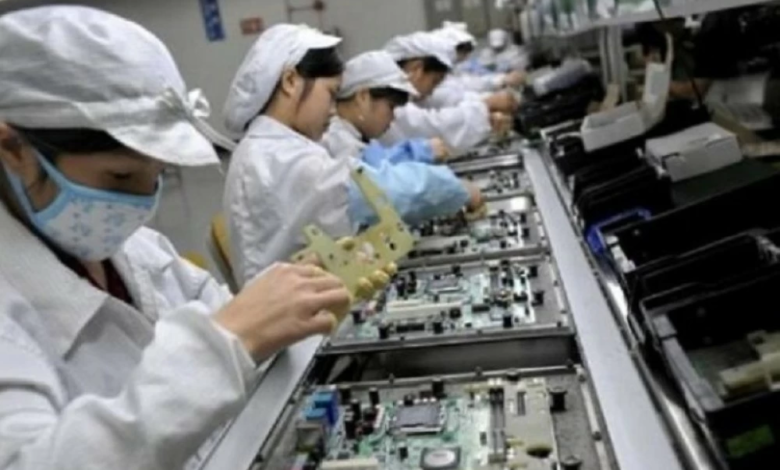

Official data released on Saturday showed a marked slowdown in Chinese manufacturing activity in January, a result that defied analysts' expectations after a slight increase in the sector at the end of last year. These figures reflect the ongoing challenges facing the world's second-largest economy as Beijing strives to solidify the foundations of economic growth.
Purchasing Managers' Index enters contraction territory
China's National Bureau of Statistics announced that the Purchasing Managers' Index (PMI), a key gauge of factory performance and industrial activity, fell to 49.3 this month. This decline is considered a negative indicator, as it fell short of expectations of a stable reading of 50.1. Economically, a reading below 50 is generally considered the dividing line between expansion and contraction, meaning that China's manufacturing sector has begun the new year with a de facto slowdown.
Economic context and reasons for the decline
Huo Lehui, an expert at the National Bureau of Statistics, attributed the decline to “insufficient actual market demand,” in addition to the effects of the “traditional off-season,” which typically coincides with the Lunar New Year holidays, when many factories cease operations. This slowdown ends a short-lived upward trend seen last December, bringing back memories of the weak performance the economy has suffered since April of last year.
Structural challenges: from real estate to demographics
This slowdown cannot be viewed in isolation from the structural crises plaguing the Chinese economy. The real estate market, which for many years was a major engine of growth, continues to suffer from a crippling debt crisis that discourages investment and reduces household wealth, negatively impacting citizens' willingness to spend and buy homes. Added to this is the demographic challenge of an aging population and a shrinking workforce, further complicating the reliance on domestic consumption as a substitute for exports.
Expected impacts locally and globally
This slowdown has repercussions that extend far beyond China's borders. Domestically, weak industrial activity is putting pressure on the labor market and employment rates. Globally, the slowdown in the "world's factory" could lead to a decline in demand for raw materials and commodities such as oil and metals, negatively impacting the economies that export these resources. Although China achieved a record trade surplus of $1.2 trillion in 2025, its over-reliance on exports amid weak domestic demand makes its economy vulnerable to geopolitical fluctuations and global trade tensions.
Stay tuned for upcoming government policies
With economic growth projected at 5% in 2025, one of the slowest rates in decades, attention is now focused on the annual political gathering scheduled for next March. Observers expect the Chinese government to announce a new package of stimulus policies alongside its five-year plan, aimed at boosting domestic demand and addressing imbalances in the real estate sector to prevent the economy from slipping into a deeper recession.