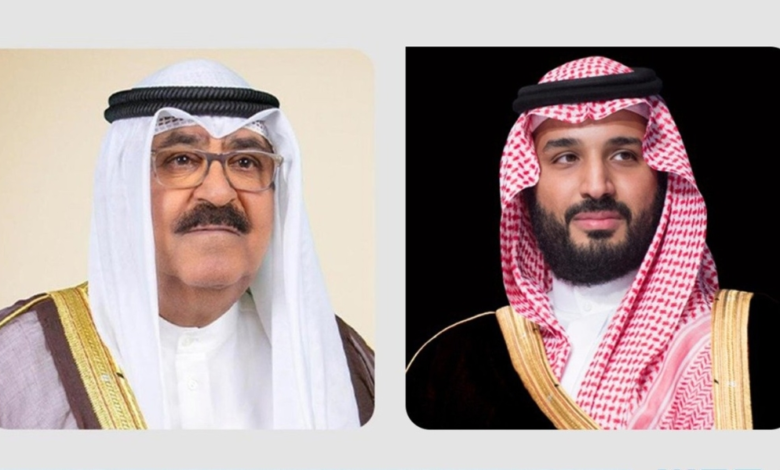
The Crown Prince and the Emir of Kuwait discuss regional security developments by phone

His Royal Highness Prince Mohammed bin Salman bin Abdulaziz Al Saud , Crown Prince and Prime Minister of the Kingdom of Saudi Arabia, made a telephone call on Thursday to His Highness Sheikh Mishal Al-Ahmad Al-Jaber Al-Sabah , Emir of the State of Kuwait. The two sides began the call by exchanging warmest congratulations and best wishes on the occasion of Eid al-Fitr, praying to God Almighty that this great Islamic occasion returns to the two brotherly countries and peoples, and to the Arab and Islamic nations, with goodness, prosperity, security, safety, stability, and lasting well-being.
The depth of historical relations between Saudi Arabia and Kuwait
These high-level telephone conversations are a continuation of the deep historical relations and strong fraternal ties that have bound the Kingdom of Saudi Arabia and the State of Kuwait for decades. The ongoing coordination and constant consultation between the two leaderships is a fundamental pillar and backbone of the Gulf Cooperation Council (GCC) . Throughout their shared history, Riyadh and Kuwait have consistently aligned their visions and political stances on various regional and international issues, reflecting a shared and strategic commitment to strengthening Gulf solidarity and confronting common challenges as a unified team, based on a shared destiny and a history rich in constructive cooperation across all political, economic, and security fields.
Discussion of developments in the region and security challenges
On the political and security front, which occupied a significant portion of the call, the Saudi Crown Prince and the Emir of Kuwait reviewed the latest developments in the region and their direct repercussions on regional security and stability. In this sensitive context, the unified Gulf position against any threats to the sovereignty of the GCC states was clearly and firmly reaffirmed. During the call, emphasis was placed on the fact that the repeated hostile attacks, particularly those perpetrated by Iran or supported by external actors against GCC states, and the targeting of their vital, economic, and civilian infrastructure, constitute a dangerous military and security escalation. This unacceptable escalation not only threatens the security and stability of the region but also represents a flagrant violation of international laws and norms.
The regional and international impact of Gulf stability
These bilateral talks hold immense strategic importance on several levels. Locally and regionally, they send a strong message of reassurance to the people of the region that the Gulf leadership places national security and the protection of national achievements at the forefront of its priorities. Internationally, the stability of the Arabian Gulf region is a key safeguard for the entire global economy, given the region's paramount strategic importance in securing global energy supplies and protecting maritime navigation and international trade. Therefore, any threat to the security of the Gulf or its vital infrastructure is a direct threat to international peace and security.
A unified and firm Gulf stance
At the conclusion of the talks, both sides reaffirmed their unwavering commitment that the Gulf Cooperation Council (GCC) states will always remain united and resolute, continuing to exert every effort and dedicate all necessary resources and capabilities to defending their territories and sovereignty. They also emphasized the importance of supporting all regional and international efforts aimed at preserving security and stability, ensuring the continuation of the comprehensive development and prosperity witnessed by the Gulf states, and sparing the region the ravages of conflict.