La Liga, the Spanish football league, officially released its financial report detailing the distribution of television broadcasting rights revenue to clubs for the 2024-2025 season. This annual step aims to reinforce the principle of financial transparency that the league has upheld for years. The figures revealed substantial sums flowing into club coffers, representing a vital lifeline for the Spanish sports economy.
Distribution figures: The battle at the top shifts to revenue
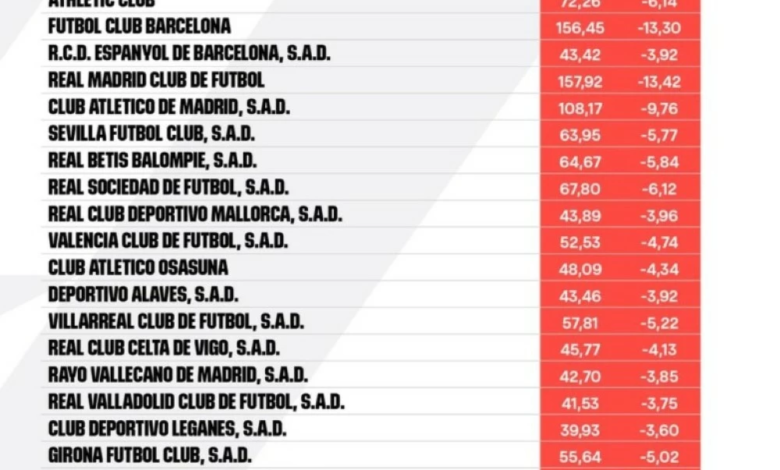
According to official figures, the total financial distribution to top-flight clubs amounted to approximately €1.43 billion. Despite a slight decrease compared to previous seasons, which the league attributed to challenges in international broadcasting markets and currency fluctuations, the figures remained substantial.
Real Madrid topped the revenue charts with approximately €158 million, narrowly edging out their arch-rivals Barcelona , who earned around €156 million. Atlético Madrid in third, securing over €108 million, cementing the trio's position as a dominant economic and sporting force in Spain.
Historical background: From individual to centralized selling
To understand the significance of this report, we must return to the historical context and the radical transformation that Spanish football has undergone. Before 2015, Spanish clubs sold their broadcasting rights individually, giving Real Madrid and Barcelona the lion's share and creating a huge financial gap with the other teams. With the royal decree in 2015 mandating the "centralized sale" of broadcasting rights, the equation changed, moving closer to the English Premier League model, with the aim of ensuring the competition's competitiveness and sustainability.
Complex distribution criteria
The association explained that the mechanism for distributing this wealth is not done randomly, but is subject to a precise system consisting of three basic criteria:
- 50% equally: Half of the total amount is distributed equally among all 20 clubs in the top division, to ensure a minimum income for everyone.
- 25% for athletic performance: Based on the team's league ranking over the last five years, rewarding consistency in success.
- 25% for social value (Implantación Social): This includes ticket sales, television viewership, and contribution to promoting the league, a criterion that often favors clubs with overwhelming popularity.
Economic impact and global challenges
This distribution comes at a time when European leagues are facing major economic challenges and fierce competition, particularly from the English Premier League, whose broadcasting revenues far exceed those of La Liga. Through this relatively fair distribution, La Liga aims to enable smaller and mid-sized clubs to retain their talent and comply with the strict Financial Fair Play regulations imposed by the league and UEFA, thus ensuring that the Spanish league remains a global entertainment product capable of attracting viewers from across the globe.