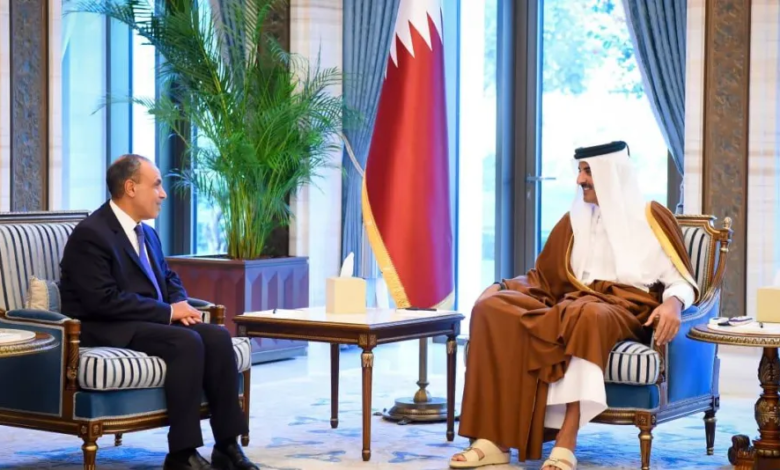

Details of the meeting between the Egyptian Foreign Minister and the Emir of Qatar
As part of intensive diplomatic efforts to contain the escalating crises in the Middle East, the Egyptian Foreign Minister held important and extensive talks with the Emir of Qatar, Sheikh Tamim bin Hamad Al Thani, in the Qatari capital, Doha. These talks focused primarily on ways to de-escalate tensions in the region and prevent it from sliding into a full-blown war that could destabilize countries and harm the interests of their people. This visit comes at a highly sensitive time, as the regional arena is witnessing unprecedented tensions that necessitate high-level coordination among key Arab capitals.
General context and historical background of Egyptian-Qatari coordination
Historically, both the Arab Republic of Egypt and the State of Qatar have played a pivotal role in mediating and resolving conflicts in the Middle East, particularly concerning the Palestinian issue. Since the outbreak of the latest war in the Gaza Strip, Cairo and Doha, along with the United States, have formed a tripartite mediation committee aimed at reaching ceasefire agreements and prisoner exchanges. This joint coordination is not a recent development, but rather the culmination of years of joint diplomatic efforts to ensure the delivery of humanitarian aid and alleviate the suffering of civilians, as well as previous reconstruction efforts in the Strip and attempts to bridge the gap between Palestinian factions and Israel.
The importance of the talks and their expected impact on the stability of the region
The talks between the Egyptian Foreign Minister and the Emir of Qatar are of exceptional importance on several levels, and their effects are reflected at the local, regional and international levels:
Regional impact
At the regional level, the two leaderships are working to unify Arab visions and positions to push for de-escalation. The continued military escalation threatens to widen the conflict to include other fronts, such as southern Lebanon and the Red Sea region, which portends serious security repercussions for all neighboring countries. Egyptian-Qatari coordination is acting as a diplomatic bulwark to prevent this catastrophic scenario by maintaining continuous communication channels with all relevant parties and attempting to find common ground to prevent a complete security breakdown.
International influence
Internationally, the Egyptian-Qatari efforts are viewed by the international community as a cornerstone of peace in the Middle East. Current tensions have directly impacted international shipping and global trade, particularly in the Red Sea and the Suez Canal. Therefore, the success of de-escalation efforts in the region enjoys broad support from major powers and the United Nations, which rely on the wisdom of Arab diplomacy to defuse the crisis and restore stability, thus serving international peace and security and protecting the global economy from further shocks.
Humanitarian and local repercussions
On the local and humanitarian level, the ultimate goal of these efforts is to immediately halt the bloodshed in the Palestinian territories. The discussions prioritize ensuring the safe and sustained flow of humanitarian and medical aid to the Gaza Strip and removing any obstacles to this. These efforts also pave the way for the resumption of the political process based on the two-state solution, which is the only guarantee for achieving a just, comprehensive, and lasting peace in the region, ensuring the rights of the Palestinian people and achieving security for all.