Al-Iryani to Asharq Al-Awsat: The truth about promoting the return of terrorism in Yemen

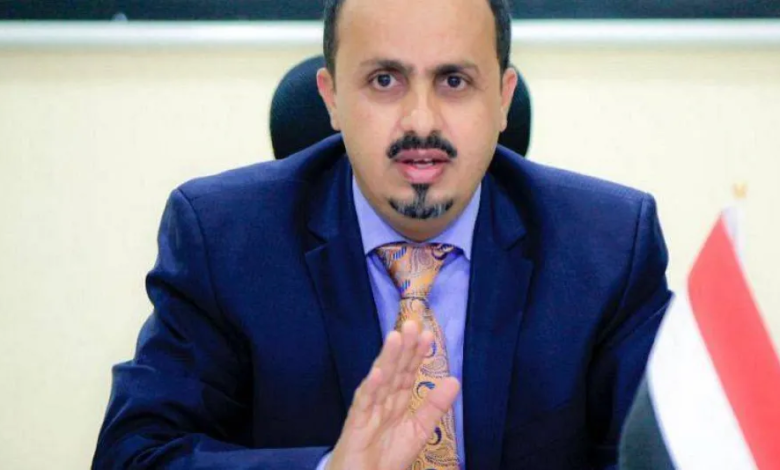
In remarkable statements to the newspaper “Al-Sharq Al-Awsat”, the Yemeni Minister of Information, Culture and Tourism, Muammar Al-Iryani, confirmed that the parties that promote, through media and politics, the return of terrorist organizations’ activity in Yemen are the same parties that provide them with support and cover, pointing to the existence of a clear relationship of mutual benefit between the coup militias and these organizations to destabilize the security and stability of the liberated areas.
Context of the statements and background of the conflict
Minister Al-Iryani's statements come at a sensitive time for the Yemeni conflict, as the internationally recognized legitimate government seeks to establish security in the liberated provinces amidst complex security challenges. The Yemeni government has consistently accused the Houthi militia of using the "terrorism" card (al-Qaeda and ISIS) as a scare tactic with the international community, or as an indirect military tool to target government forces in areas of conflict—a practice known locally and politically as "collusion" between the two sides.
Previous government and international reports indicate that extremist groups exploited the security vacuum created by the Houthi coup in 2014 to expand their influence. However, government forces, supported by the Saudi-led coalition, had previously succeeded in containing this threat. Nevertheless, the rhetoric of a "return of terrorism" resurfaces whenever political or military pressure intensifies on the militias, raising questions about the timing of these developments.
The implications of the accusation and its political impact
Al-Iryani's statement carries profound political and security implications, as it aims to expose the narrative that some parties are trying to promote to justify the continued presence of militias or to cast doubt on the legitimate government's ability to maintain security. Observers of Yemeni affairs emphasize that linking the "promoter" and the "supporter" places the international community before its responsibilities to investigate the sources of funding and arming for these groups, and how they operate freely in certain areas but not others.
The strategy of promoting the return of terrorism often aims to confuse matters, divert attention from the crimes and human rights violations committed against civilians, in addition to attempting to blackmail the region and the world with the counter-terrorism file to obtain illegitimate political gains.
The international stance and the need to unify efforts
Internationally, there are growing calls for support for the Presidential Leadership Council and the Yemeni government to enable them to extend their full control, given that a strong national state is the only guarantee for eradicating the roots of terrorism and extremism. Experts believe that the continued division and weakness of state institutions provide fertile ground for the growth of these phenomena, and that the fundamental solution lies in ending the coup and restoring state institutions.
This position concludes by emphasizing that the fight against terrorism in Yemen cannot be selective or fragmented, but rather requires an integrated effort that begins with exposing the parties that are investing in this bloody issue, and stopping all forms of logistical and political support that these groups receive under different names.