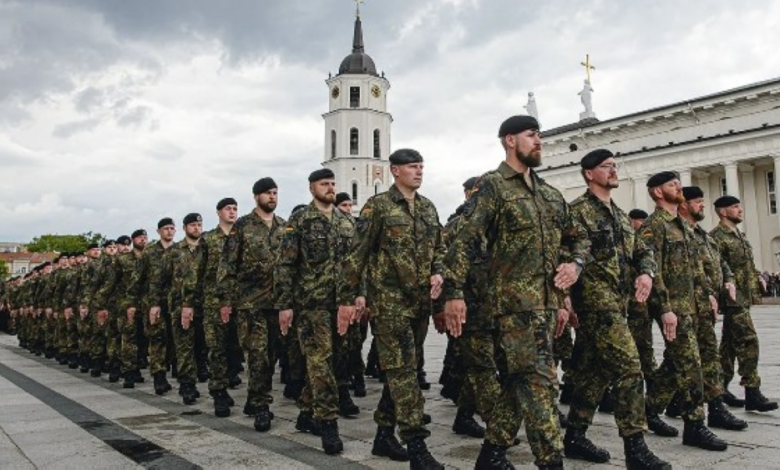
The European Union is considering forming a joint military force as an alternative to the United States

European Union's defense doctrine, EU Defence Commissioner Andrius Kubilios has called on member states to seriously consider forming a joint military force of 100,000 troops. This proposal comes as a potential strategic alternative to the US forces currently deployed on the continent, given the rapidly evolving geopolitical landscape.
Proposal details: Towards strategic independence
Former Lithuanian Prime Minister Kubilius presented his vision during a speech in Sweden , questioning how to fill the void that would be left by the absence of a permanent US military presence, which has long formed the backbone of European security. His idea centers on creating a strong, permanent European force capable of better protecting the continent without being entirely dependent on Washington.
Historical context and political motivations
Historically, since the end of World War II, Western Europe has relied heavily on the American security umbrella and the North Atlantic Treaty Organization (NATO). However, calls for a unified European army are not new; they date back decades, but have consistently been thwarted by national sovereignty and differing priorities among member states.
These calls are gaining new momentum today amid growing doubts about the continuity of the American commitment to European security, especially with the return of President Donald Trump and his erratic policies toward allies, as well as the increasing American focus on the Indo-Pacific region to counter Chinese influence. These factors have prompted European leaders to revive the concept of “strategic autonomy” to ensure the continent’s security.
Challenges facing a unified European army
Despite the merits of the proposal, establishing a centralized army faces enormous logistical and political challenges. On the one hand, member states are wary of relinquishing control of their national armies to a central command in Brussels. On the other hand, there are differing perspectives between countries that see Russia as the primary existential threat (such as the Baltic states and Poland) and other countries with different security priorities in the Mediterranean region.
In this context, Kubilius emphasized: “At times like these, we must not shy away from the most pressing questions concerning our institutional defense readiness.” These remarks come amid ongoing US pressure on European allies to assume greater security and financial responsibilities.
European Security Council proposal
As part of the proposed solutions, the European Commissioner called for the creation of a “European Security Council” comprising the continent’s major powers, with the potential inclusion of Britain (despite its exit from the European Union) given its military weight. This council would aim to make decisive decisions on defense and discuss strategic issues, focusing primarily on changing the dynamics of the war in Ukraine to ensure that Kyiv does not fall, which Europeans consider the first line of defense for their collective security.