Europe rejects Trump's ambitions in Greenland: Regional security is a red line

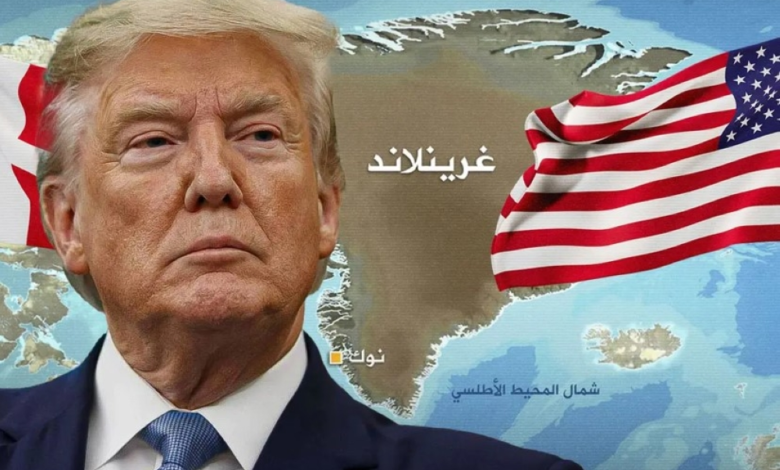
In a decisive diplomatic move reflecting European unity, several prominent European leaders announced on Tuesday their full and unconditional support for Denmark, following US President Donald Trump's renewed and controversial desire to annex Greenland. This unified European stance reaffirms respect for national sovereignty and international agreements, blocking any attempts to treat independent territories as mere real estate transactions.
Six-party statement: Sovereignty is a red line
The leaders of France, Britain, Germany, Italy, Poland, and Spain issued a joint statement, published by the German Chancellery, emphasizing that “the right to self-determination and to decide on matters relating to Greenland is a sovereign matter belonging solely to Denmark and the Government of Greenland.” The statement noted that Denmark is not merely a friendly nation, but an active member and strategic partner of NATO, just like the United States, and therefore must be treated according to the principles of mutual respect between allies.
The statement read: “The Kingdom of Denmark, including Greenland, is an integral part of NATO. Therefore, the security of the Arctic region must remain a shared responsibility of all NATO members, including the United States.” The leaders also reaffirmed their unwavering commitment to the principles of the UN Charter, specifically those concerning sovereignty, territorial integrity, and the inviolability of borders, describing them as “universal principles that they will never cease to defend.”.
The strategic importance of Greenland: Why the interest?
To understand the context of this tension, one must consider the growing geopolitical importance of Greenland. It is not merely a vast expanse of ice; it is a vital strategic location connecting North America, Europe, and Russia across the Arctic. The island also holds significant military importance due to the presence of Thule Air Base, the northernmost US military base, which plays a pivotal role in the ballistic missile early warning system and space surveillance.
In addition to its military significance, Greenland is rich in vast untapped natural resources, including rare earth minerals essential for modern technology industries, as well as oil, gas, and uranium. With the melting of its ice sheet due to climate change, new shipping routes and the potential for extracting these resources have become easier, making the island a target for major powers and reigniting American ambitions for direct control.
A history of American attempts
It is worth noting that the United States' interest in purchasing Greenland is not a recent development, nor is it limited to the Trump era. In 1946, US President Harry Truman offered Denmark $100 million in gold for the island, an offer that was rejected at the time. This debate resurfaced in 2019 during Trump's first term, when he canceled an official visit to Denmark after the Danish Prime Minister described the idea of selling the island as "absurd." The recurrence of these claims reflects a deep-seated American desire to dominate the Arctic in order to counter the growing Russian and Chinese influence in the region.
Greenland's response: A call for diplomatic dialogue
For his part, Greenland's Prime Minister, Fredrik Nielsen, welcomed the strong European support, considering it a crucial message of reassurance. Nielsen wrote on his Facebook page: "Given the US President's determination and seriousness regarding Greenland, this unequivocal support from our NATO allies removes any ambiguity about our political status.".
Nielsen concluded his statement by calling on Washington to return to the traditional diplomatic path, saying: “I call on the United States once again to engage in a respectful dialogue through diplomatic channels, and to use existing forums and pre-existing agreements, rather than unilateral statements.”.