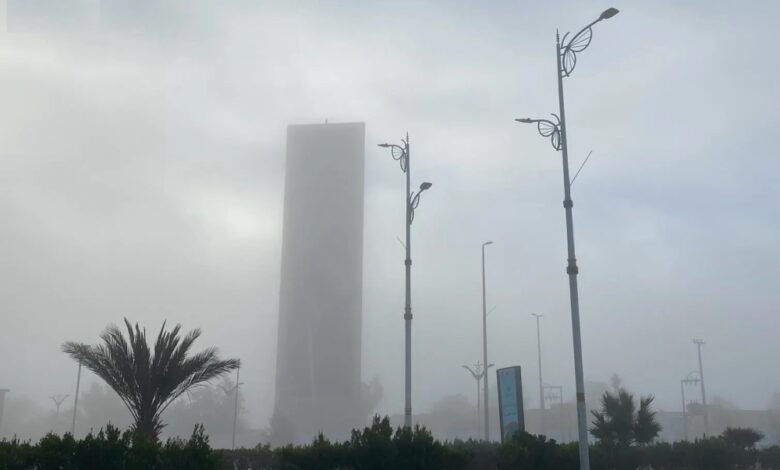

The National Center for Meteorology issued its daily weather for Saturday across Saudi Arabia, revealing significant weather fluctuations affecting large areas of the country. The report indicates a distinctly wintry atmosphere, with low temperatures combined with active surface winds creating a climate requiring caution in 11 administrative regions.
Weather details and affected areas
According to official meteorological data, the Kingdom is experiencing a significant and sharp drop in temperatures, accompanied by fog that reduces horizontal visibility, as well as dust-raising winds. The cold wave is particularly concentrated in the northern regions, including Tabuk, Al-Jawf, and the Northern Borders . Experts do not rule out the formation of frost in parts of the Tabuk highlands during the early morning hours, reflecting the peak of the winter season in those areas.
Meanwhile, the possibility of dense fog remains high across large parts of the Eastern Province , potentially affecting traffic on highways. This effect extends to the southwestern highlands of the Jazan and Asir . In central and western Saudi Arabia, surface winds are stirring up dust and sand, reducing horizontal visibility in parts of the Madinah, Hail, Qassim, and Riyadh .
The climatic and geographical context of the Kingdom
These weather fluctuations are a natural part of Saudi Arabia's continental climate, characterized by its diverse topography and vast geographical area. At this time of year, the northern regions are affected by cold air masses originating from the north, Siberia, or the Mediterranean basin, which explains why temperatures sometimes drop below freezing and frost forms. Meanwhile, the central and eastern regions are affected by wind patterns that can stir up dust and sand due to the open desert terrain—a recurring pattern that requires constant preparedness from residents and service providers.
State of the Red Sea and the Arabian Gulf
Regarding the maritime situation, the center provided the following details:
Red Sea
- Surface winds: They will be northwesterly to northerly on the northern and central parts at a speed of 25-45 km/h, while they will turn southeasterly to easterly on the southern part at a speed of 12-32 km/h, and gusts may reach 50 km/h towards the Gulf of Aqaba and the Bab al-Mandab Strait.
- Wave height: It ranges from one meter to two and a half meters in the north and center, and from half a meter to one and a half meters in the south, and may exceed two meters at Bab al-Mandab.
- Sea conditions: It is described as moderate to rough in the north and center, and light to moderate in the south.
Arabian Gulf
- Surface winds: Northerly to northwesterly (north and central) at a speed of 18-40 km/h, and northwesterly to westerly (south) at a speed of 10-28 km/h.
- Wave height: from one to two meters in the northern and central parts, and from half a meter to one meter in the southern part.
- Sea conditions: Moderate waves in the north and center, and light waves in the south.
Important recommendations for public safety
Given these forecasts, citizens and residents, especially drivers on highways in areas affected by dust and fog, are advised to exercise extreme caution, maintain safe distances, and use appropriate lighting. Residents of northern regions are also advised to wear heavy winter clothing to avoid catching colds due to the expected sharp drop in temperatures and frost.