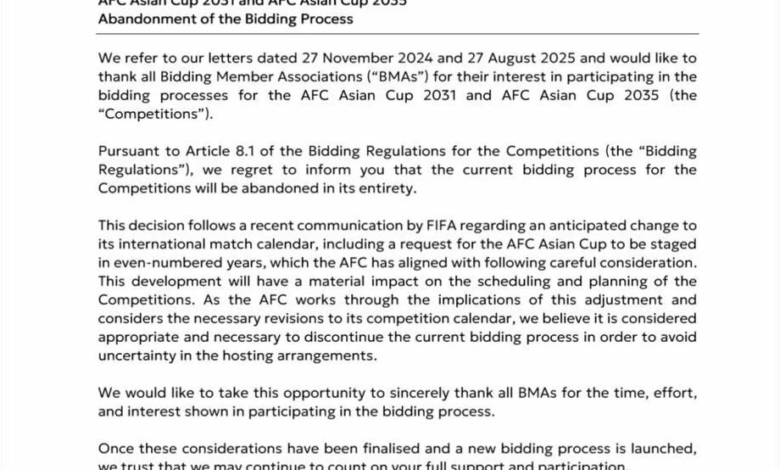
FIFA requests adjustments to the dates of Asian tournaments for even-numbered years

In a strategic move aimed at unifying the global football calendar, FIFA has recommended that the Asian Football Confederation (AFC) make significant changes to the scheduling of major Asian tournaments. The recommendation includes avoiding holding continental championships in odd-numbered years and instead staging them in even-numbered years. This approach aims to ensure that Asian tournament dates do not clash with FIFA's international match calendar and to alleviate pressure on players and clubs worldwide.
Cancellation of bids for the 2031 and 2035 AFC Asian Cup tournaments
In response to these recommendations, the Asian Football Confederation (AFC) made decisive decisions, officially announcing to the countries that had submitted bids to host the 2031 and 2035 Asian Cup tournaments that the bidding process had been cancelled. This sudden decision means that Asian tournaments will undergo a complete overhaul and restructuring in the next few years, in line with the new international system that FIFA is seeking to impose on all continental federations to ensure complete harmony in the competition schedules.
Historical context of the AFC Asian Cup dates
To understand the implications of this decision, we must consider the historical context of the AFC Asian Cup. The tournament was first held in 1956 and has been held regularly every four years. In 2004, the tournament was held in China, but the Asian Football Confederation (AFC) decided to move the following edition to 2007 instead of 2008 to avoid clashing with major tournaments such as the UEFA European Championship and the Summer Olympic Games. Since then, the tournament has continued to be held in odd-numbered years (2011, 2015, 2019, 2023). Now, FIFA is requesting a reversal of this trend to align with recent developments in the world of football.
The importance of the amendment and its impact on the international agenda
This step is of paramount importance both internationally and regionally. Internationally, FIFA seeks to organize the international match calendar to prevent scheduling conflicts, especially with the introduction of new tournaments and the expansion of existing ones, such as the Club World Cup with 32 teams and the World Cup with 48 teams. Holding the Asian Cup in even-numbered years will facilitate the release of international players who play professionally in major European leagues, as European clubs have long suffered from losing their Asian stars mid-season, leading to recurring crises between clubs and national teams.
Regional impact and the future of hosting
At the regional and local levels, this amendment will require Asian national federations to reschedule their domestic competitions to align with the new dates. It is worth noting that Saudi Arabia is preparing to host the 2027 AFC Asian Cup, which may be the last edition held in an odd-numbered year before the new format is implemented. This change will give countries wishing to host future editions an opportunity to reassess their bids and submit proposals that meet the new scheduling and organizational requirements set by the Asian Football Confederation.
In conclusion, FIFA's request to adjust the dates of Asian tournaments represents a necessary step towards a more organized future for global football. While the Asian Football Confederation (AFC) may face short-term logistical challenges in restructuring its competitions, the long-term benefits of protecting players from burnout, reducing clashes with clubs, and ensuring a more harmonious international calendar make this adjustment a strategic decision that serves the best interests of the game and its development in Asia and worldwide.