The Foreign Minister discusses regional issues with his Jordanian counterpart, Ayman Safadi

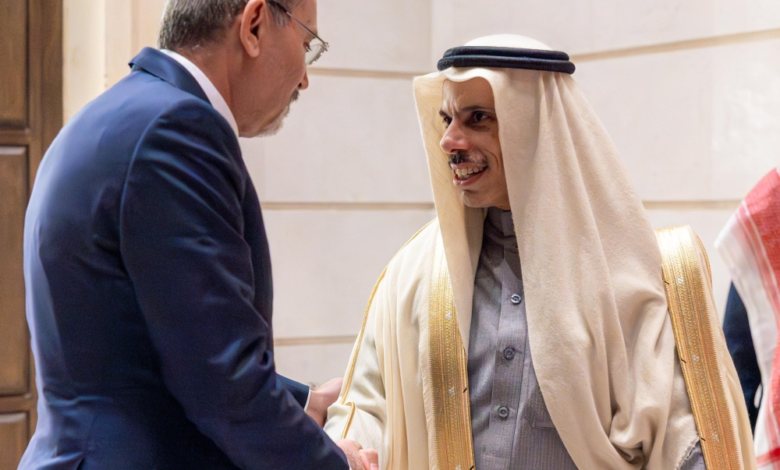
As part of ongoing efforts to strengthen fraternal ties and cooperation, the Foreign Minister received his Jordanian counterpart, Deputy Prime Minister and Minister of Foreign Affairs and Expatriates Ayman Safadi, in a high-level diplomatic meeting aimed at coordinating positions on regional and international issues of common interest. This meeting comes at a sensitive time for the Middle East region, necessitating intensified consultations among Arab capitals to ensure regional stability and security.
The importance of diplomatic coordination in light of current challenges
This visit is of particular importance given the pivotal role played by the Hashemite Kingdom of Jordan in regional politics. Jordan, by virtue of its geostrategic location, is a cornerstone of the Arab national security system. Discussions between the two ministers focused on the need to develop a unified Arab vision to confront escalating challenges, ranging from security tensions in neighboring countries to global economic challenges that are impacting the region's economies.
The Palestinian issue: a constant focus of discussions
No diplomatic meeting with the Jordanian side can overlook the centrality of the Palestinian issue. Both sides reviewed the latest developments in the occupied Palestinian territories, emphasizing the Arab principles of the necessity to reach a just and comprehensive solution that guarantees the establishment of an independent Palestinian state with East Jerusalem as its capital, based on the June 4, 1967 borders. They also discussed the importance of the Hashemite custodianship of the Islamic and Christian holy sites in Jerusalem, and its role in preserving the Arab identity of the holy city in the face of attempts at demographic and political change.
Strengthening bilateral relations and economic cooperation
On the bilateral level, the two ministers discussed ways to develop cooperation in various fields, particularly in the economic, trade, and investment sectors. They emphasized the importance of activating joint agreements and increasing the volume of trade to serve the interests of both nations. The two sides also discussed energy, water, and food security, considering them vital issues requiring Arab integration to address resource scarcity and climate change.
Regional and international context
These talks come amidst active diplomatic efforts in the region to de-escalate the crises in Syria, Yemen, and Libya, with both sides agreeing that political solutions are the only way to end these conflicts. Coordination with Jordan is an integral part of the joint Arab action strategy, given Jordan's long experience in diplomacy and its balanced relations with influential international powers, making this meeting a positive step towards strengthening the Arab position in international forums.
At the conclusion of the meeting, the two ministers stressed the continuation of ongoing coordination and consultation, and working to prepare for upcoming diplomatic events, including meetings of the League of Arab States, to ensure that they produce resolutions that meet the aspirations of the Arab peoples for security and prosperity.