
In the age of the digital revolution, where the pace of information flow is accelerating and platforms are multiplying, a fundamental question arises that concerns both the public and decision-makers alike: Where do the limits of freedom of expression and the limits of media chaos begin? This discussion is not an intellectual luxury, but rather an urgent necessity to regulate the rhythm of the public sphere, especially in light of the great overlap between personal opinions and verified news.
Information Minister's statements: Firmness in the face of chaos
This statement coincides with the Minister of Information's firm assurances that any attempts to exploit the available freedoms to incite chaos or inflame public opinion will not be tolerated. The Minister emphasized that freedom of expression is guaranteed and protected by law, but it is not a blank check to transgress against established principles or harm social peace.
General context: Challenges of the digital age
Historically, traditional media outlets served as gatekeepers of information, facilitating fact-checking and verification. Today, however, with the rise of social media platforms, every individual has become a potential "publisher," creating a fertile ground for the spread of rumors and misinformation. This radical shift has presented new challenges for policymakers in Saudi Arabia and around the world, necessitating updated regulatory frameworks to ensure these platforms do not become instruments of destruction rather than constructive change.
Freedom of expression is a guaranteed right, but with limits
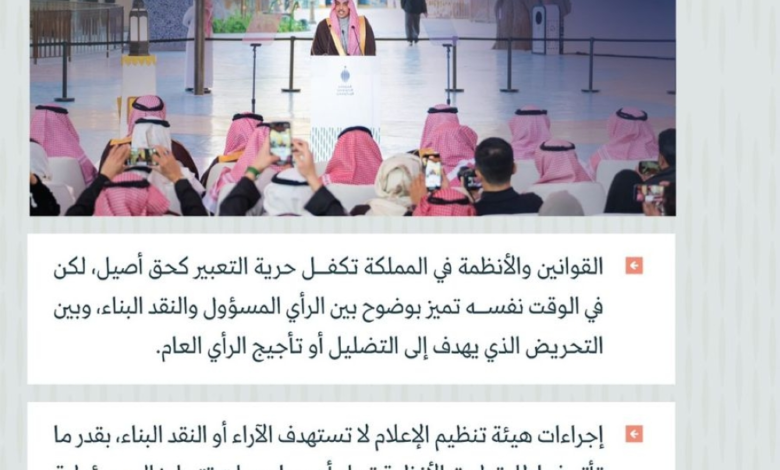
The laws in the Kingdom clearly guarantee freedom of expression, including the right to express opinions and offer constructive criticism. The state considers objective criticism essential for improving governmental and institutional performance and correcting erroneous practices. However, this freedom is conditional upon adherence to regulations that protect the rights of others and serve the higher public interest, refraining from personal attacks or actions that threaten national security.
Manifestations of media chaos and its impact
According to media regulations, the problem lies not in expressing opinions themselves, but in the unprofessional practices that accompany them. This media chaos manifests itself in several serious ways, including:
- Spreading inaccurate or misleading information (Fake News).
- Taking official statements out of context or distorting them to achieve specific agendas.
- Inflaming public opinion and inciting against institutions or individuals.
- Abuse and defamation without relying on credible documents or evidence.
The impact of these practices is not limited to mere annoyance, but extends to pose a threat to social and economic stability, as rumors undermine trust between society and its institutions, and may cause economic losses or security tensions with dire consequences.
Regulation: Protection for society, not silencing voices
In this context, Al-Dossari emphasized that media regulation does not, in any way, target free expression or responsible criticism. The primary objective is to curb practices that exceed professional standards and contribute to spreading confusion. Regulating the media landscape aims to achieve a delicate balance between freedom of expression and social responsibility, protect society from information chaos, and enhance credibility and professionalism to support a responsible media that effectively contributes to the Kingdom's ongoing development and stability.