Gulf Cooperation Council Ministerial Council: Decisive measures to deter Iranian attacks

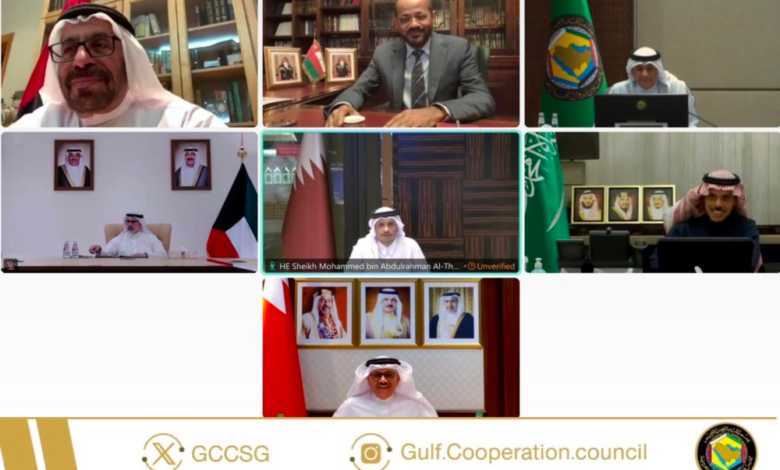
The Ministerial Council of the Cooperation Council for the Arab States of the Gulf (GCC) held its 50th extraordinary meeting via video conference on Sunday, chaired by Dr. Abdul Latif bin Rashid Al Zayani, Minister of Foreign Affairs of the Kingdom of Bahrain (Chairman of the current session), with the participation of Their Highnesses and Excellencies the Foreign Ministers of the GCC member states, and His Excellency the Secretary-General of the Council, Jassim Mohammed Al-Budaiwi. This emergency meeting was convened to discuss the serious developments represented by the Iranian attacks targeting the security and stability of the region.
Details of the attacks and their security implications
The ministers discussed at length the unjustified Iranian attacks using missiles and drones, which targeted all GCC countries (the UAE, Bahrain, Saudi Arabia, Oman, Qatar, and Kuwait) starting on Saturday, February 28, 2026. The Council examined the extent of the significant damage caused by this treacherous aggression, which directly targeted civilian facilities, service sites, and densely populated residential areas, posing a clear threat to the lives of citizens and residents and causing substantial material losses, in flagrant violation of all humanitarian values and international norms.
The unified Gulf position: Security is indivisible
In reaffirming their unity and shared destiny, the Ministerial Council stressed that the security of the GCC states is indivisible, considering any attack on any member state as a direct attack on all member states without exception. This position is based on the GCC Charter and the Joint Defense Agreement, which establish a collective security system capable of deterring threats.
The Council affirmed that member states retain their full legal right to respond and defend themselves, based on Article 51 of the Charter of the United Nations, which guarantees states the right of individual and collective self-defense in the event of any armed aggression. The statement also indicated the Council states' determination to take all necessary measures to preserve their sovereignty and ensure the stability of their peoples.
Strategic dimensions and their impact on the global economy
The statement did not focus solely on the immediate security implications, but also addressed the geopolitical and economic repercussions of these attacks. The Council warned of the danger these escalations pose to the security of waterways and freedom of navigation in one of the world's most vital regions. The ministers emphasized that the stability of the Arabian Gulf region is not merely a regional matter, but a cornerstone of global economic stability, ensuring the smooth flow of supply chains and maintaining the balance of global energy markets, thus necessitating a firm international stance.
Call for urgent international action
The Ministerial Council called upon the international community and the Security Council to uphold their legal and moral responsibilities and take immediate and decisive action to halt these Iranian violations that threaten international peace and security. At the same time, the Council commended the efficiency and readiness of the armed forces and air defense systems of member states, which successfully countered numerous missile and drone attacks with high professionalism, thus contributing to neutralizing threats and protecting lives and property.
The Council concluded its statement by emphasizing that the Gulf States, despite their constant pursuit of dialogue and diplomacy as a strategic option, will not compromise on protecting their national security, expressing sincere condolences to the families of the victims and wishes for a speedy recovery to the injured.