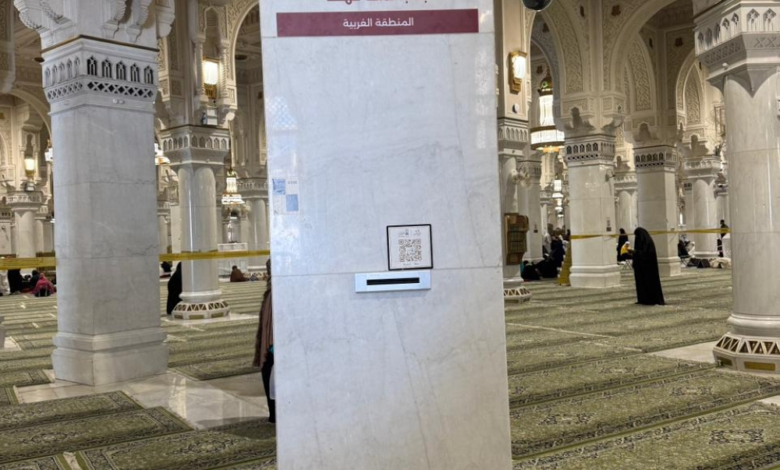
The project to label the columns in the Grand Mosque with 350 directional signs

The General Authority for the Care of the Grand Mosque and the Prophet's Mosque has launched a new, high-quality project aimed at facilitating the journey of pilgrims to the Grand Mosque in Mecca. This achievement involves the implementation of a project to label the columns with 350 carefully distributed directional signs throughout the Grand Mosque's arcades. This strategic project coincides with the millions of visitors who flock to the Grand Mosque during the holy month of Ramadan, ensuring a smooth and accessible spiritual experience for worshippers, pilgrims, and visitors, and enhancing the efficiency of spatial guidance in a professional manner.
General context and improvement of services at the Two Holy Mosques
Historically, the Kingdom of Saudi Arabia has always given great attention to developing the infrastructure and services of the Two Holy Mosques. The Grand Mosque has witnessed successive historical expansions to accommodate the increasing numbers of Muslims. This project represents an extension of the ongoing efforts of the wise leadership to serve Islam and Muslims. In the modern context, this technological and organizational development aligns with the goals of the Kingdom’s Vision 2030, specifically the “Guests of God Service Program,” which seeks to bring about a qualitative leap in the quality of services provided, facilitate the hosting of millions of Umrah and Hajj pilgrims from around the world, and overcome all obstacles they may face, including the challenges of navigating the vast spaces and complex architecture of the Grand Mosque.
An innovative visual identity to facilitate identification
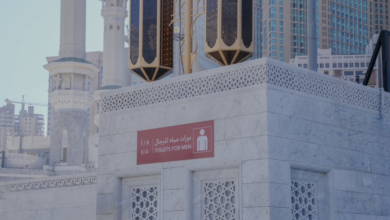
In this project, the Authority relies on an advanced guidance system based on a clear and well-thought-out visual identity. The new directional signs are designed using specific color codes and identification numbers directly linked to the names of the main gates and major geographical areas of the Grand Mosque (north, south, east, and west). This intelligent design allows users to pinpoint their location with high accuracy. The Authority also ensured the inclusion of alphabetically ordered sub-letters that align with the flow of pilgrims performing Sa'i and Tawaf, providing a consistent and easily readable guidance system from various angles and distances, thus efficiently and smoothly serving the millions of people who frequent the area.
Advanced geometric layout that takes into account architectural features
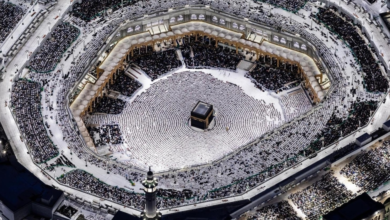
The distribution of the 350 signs was not arbitrary; rather, the General Presidency for the Affairs of the Two Holy Mosques took into account the unique architectural characteristics of each area within the Grand Mosque. A ring-shaped layout was adopted in the portico building to align with the movement of pilgrims circumambulating the Kaaba. A radial pattern was implemented in the Third Saudi Expansion to ensure clear visibility from multiple angles. The Second Expansion employed a parallel horizontal layout, which complements the main walkways. The signs extend axially from the Kaaba to the outer gates, providing interconnected directional pathways that enhance spatial organization.
Project importance and its regional and international impact
Locally, the column coding project is expected to revolutionize crowd management, reducing navigation time within the Grand Mosque and preventing overcrowding in main corridors, especially during peak hours. Regionally and internationally, this project sends a clear message to the Muslim world about the advanced technological and engineering capabilities the Kingdom is harnessing to serve pilgrims. Overcoming the language barrier through color-coded and visual navigation is a pioneering global step in crowd management at holy sites, underscoring the General Presidency for the Affairs of the Two Holy Mosques' commitment to implementing best engineering and technological practices in spatial guidance. This commitment aims to develop innovative solutions that enrich the experience of worshippers in a safe and organized environment.