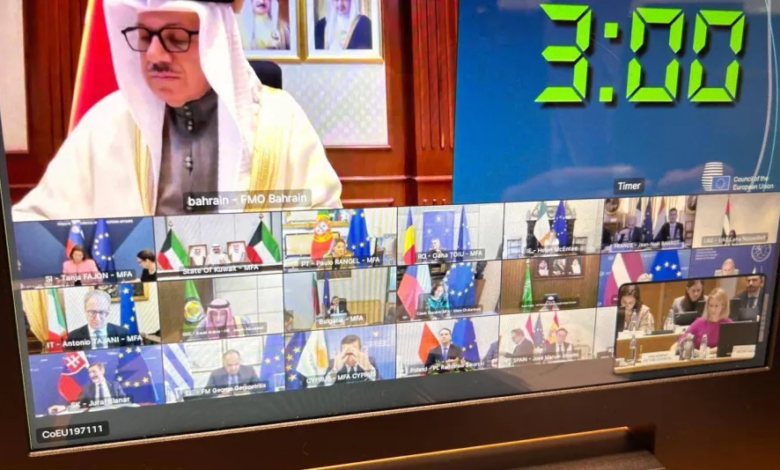

Recent talks between the Gulf Cooperation Council (GCC) and the European Union (EU) have confirmed a deep strategic consensus on the need for an immediate end to the ongoing war in the region and for concerted efforts to ensure stability in the Middle East and prevent further escalation. This consensus reflects the shared political will of both sides to address current crises with a sense of international responsibility, prioritizing the protection of civilians and the opening of humanitarian corridors as an urgent and paramount objective.
The depth of historical relations and strategic partnership
This alignment is not a recent development, but rather the product of decades of robust diplomatic and economic relations between the Gulf Cooperation Council (GCC) countries and the European Union (EU). The roots of this partnership trace back to the 1988 Cooperation Agreement, which paved the way for regular political dialogue and extensive economic cooperation. Over the years, the two sides have held a series of ministerial meetings and summits, consistently aimed at aligning their perspectives on regional and international issues, thus making them indispensable partners in maintaining international peace and security.
Regional context and the importance of timing
This Gulf-European consensus comes at a highly sensitive time, as the Middle East region witnesses unprecedented geopolitical tensions that threaten to ignite wider conflicts. European countries, like the Gulf states, recognize that the continuation of the war not only threatens the security of neighboring countries but also casts a dark shadow on global security, including energy security, supply chains, and international trade. Hence, the importance of joint calls for de-escalation and restraint, and adherence to the principles of international law and international humanitarian law as the fundamental framework for resolving conflicts, becomes clear.
Expected impact: locally and internationally
This unified stance is expected to have tangible effects on several levels. Regionally, this consensus constitutes a powerful diplomatic leverage point for pushing towards sustainable political solutions instead of military ones, while reviving pathways to a just and comprehensive peace, including the continued emphasis on the two-state solution as a strategic option. Internationally, Gulf-European coordination enhances the prospects for global economic stability, given the pivotal role of the Gulf states in energy markets and the significant economic role of the European Union. The combined efforts of these two powers send a clear message to the international community about the necessity of taking effective action to end human suffering and consolidate stability in a region that is a vital artery for the entire world.