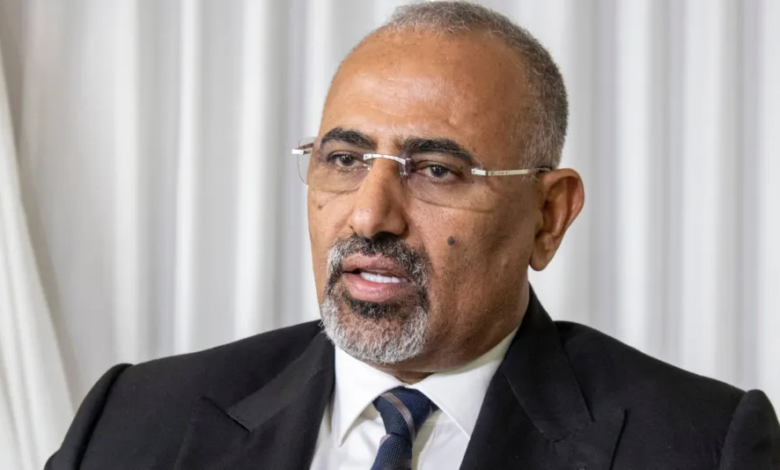

The news circulating about the removal of Major General Aidarus al-Zubaidi from the Yemeni Presidential Leadership Council and the accusation of "high treason" leveled against him has sparked widespread controversy in political and media circles, highlighting the depth of the political crisis and the legal complexities plaguing the Yemeni landscape. This event comes at a highly sensitive time, as the country witnesses intensive international and regional efforts aimed at finding a formula to end the years-long conflict.
General context and formation of the Presidential Leadership Council
To understand the dimensions of this event, we must go back a little, specifically to April 7, 2022, when the formation of the Yemeni Presidential Leadership Council was announced in the Saudi capital, Riyadh. This formation came as a result of the transfer of power from former President Abd Rabbuh Mansur Hadi, with the aim of unifying the anti-Houthi (Ansar Allah) front and integrating the various military formations under one umbrella. Aidarus al-Zubaidi, who also heads the Southern Transitional Council, is a member of this council, making him a significant figure in the Yemeni political equation due to his military and popular influence in the southern governorates.
The implications of the charge of "high treason" in the Yemeni conflict
The term “high treason” has become a tool in the current Yemeni political lexicon, used in the legal and political battles between the warring parties. On one hand, the Houthi-controlled judicial authorities in Sana'a have consistently issued death sentences and asset confiscations against members of the Presidential Leadership Council, including al-Zubaidi, on charges of “espionage with foreign countries” and “high treason.” On the other hand, internal disagreements within the legitimate government camp periodically surface regarding differing visions for the future form of the state (unity or secession), which may explain the use of such terms in the context of sharp political squabbles or media leaks aimed at muddying the waters.
Strategic importance and expected impact
Any action that affects al-Zubaidi's membership or political standing will have serious repercussions at the local and regional levels:
- Locally: This could lead to a fracturing of the Presidential Leadership Council, which already suffers from structural differences, threatening to collapse the fragile consensus between the northern and southern components, and could return the military scene in Aden and the neighboring governorates to square one.
- Regionally, al-Zubaidi represents a broad movement calling for secession and the restoration of the South Yemeni state, an issue closely monitored by the Arab Coalition led by Saudi Arabia and the United Arab Emirates. Any ill-considered shift in this equation could disrupt security calculations in the Bab al-Mandab Strait and the Gulf of Aden.
- Internationally: These political disturbances may negatively affect the efforts of the UN envoy and the ongoing negotiations to establish a truce and reach a comprehensive political solution, as peace requires a cohesive and strong government party capable of adhering to commitments.
In conclusion, the Yemeni scene remains open to all possibilities, as legal paths intertwine with military conflicts and political agendas, making the stability of state institutions, foremost among them the Presidential Leadership Council, an existential challenge for the future of Yemen.