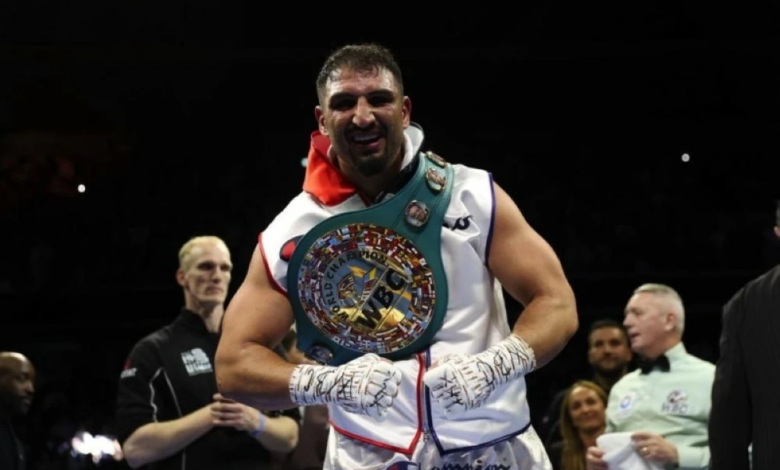

German boxer Ajit Kabayel has announced his strong desire and complete readiness to fight a historic bout for the "World Heavyweight Championship" title against Ukrainian Oleksandr Usyk, who is currently ranked as the best boxer in the world in this category, in a move aimed at restoring the glory of German boxing to the global forefront.
A resounding victory and a message of defiance
This announcement came after Cabayel's dominant performance on Saturday night, where he secured a knockout victory over his Polish opponent, Damian Kniepa, in just the third round. With this win, Cabayel retained his WBC interim world title, extending his undefeated record. The German boxer confidently stated after the fight: "Yes, I believe I deserve this fight, and I'm fully prepared. Neither of us has suffered a defeat yet. Let's go, why not?".
The German dream and the legacy of Max Schmeling
This fight is more than just another sporting milestone in the career of 33-year-old Cappell; it holds profound historical significance for German sport. After securing his 27th professional victory, Cappell aspires to become only the second German boxer in history to win the world heavyweight championship. He aims to replicate the legendary achievement of Max Schmeling, who reigned supreme in the 1930s for over 95 years, remaining the only German to have held the world heavyweight title. This places a national responsibility on Cappell to revive this legacy.
Osieck... the toughest obstacle
The team around Kabayel is aware of the daunting task ahead against Ukrainian Oleksandr Usyk, a phenomenon in the boxing world thanks to his superior technique and speed, which have enabled him to defeat heavyweight giants in recent years and unify the belts. However, Kabayel believes his clean record and high ambition qualify him to be a true match for Usyk in a fight that could reshape the world of boxing.
Plans to hold the fight in Germany
In preparation for this highly anticipated event, British businessman Spencer Brown, manager of Kabayel, revealed to the German Press Agency (DPA) that negotiations are underway and there is a strong possibility that the fight will be held in Germany. Brown explained that a bout of the magnitude of the Usyk fight requires extensive logistical preparations and a venue with a large capacity.
Brown indicated that the plan aims to attract around 75,000 spectators, suggesting the possibility of holding the fight in one of the major stadiums such as the Veltins-Arena in Gelsenkirchen or the Mercury Spiel-Arena in Düsseldorf. If successful, this move would provide a huge economic and tourism boost to the host city, as well as re-establish Germany as a leading destination for major international boxing matches.