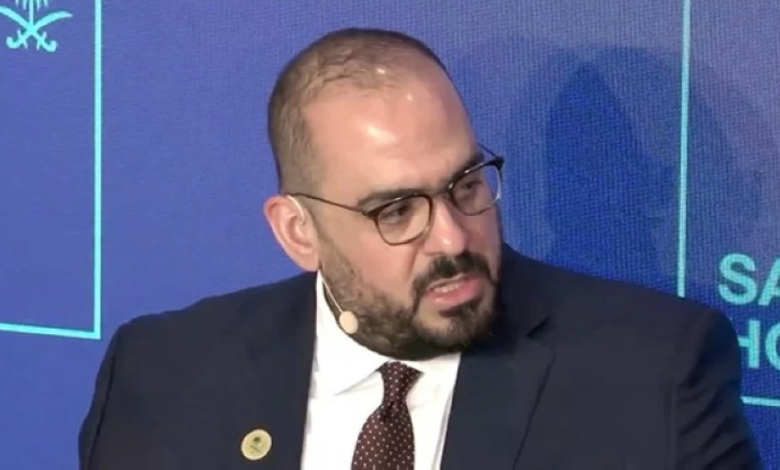
Faisal Al-Ibrahim: Long-term vision and flexibility are the pillars of development

His Excellency the Minister of Economy and Planning, Mr. Faisal bin Fadhil Al-Ibrahim, stressed the importance of countries and governments adopting long-term strategic visions, with the necessity of insisting on achieving them no matter what the challenges, while emphasizing at the same time the vitality of balancing the monitoring of future opportunities and risks and dealing immediately with short-term requirements.
This came during His Excellency’s participation in a dialogue session held on the sidelines of the World Economic Forum Annual Meeting 2026 in Davos, Switzerland, where he highlighted the economic methodology followed by the Kingdom of Saudi Arabia in light of the accelerating global changes.
Flexibility and discipline: The equation for Saudi success
Al-Ibrahim explained that the success of development plans depends on a precise equation that combines speed and discipline in implementing urgent projects with high flexibility in adapting to new developments. He pointed out that since the launch of Saudi Vision 2030, the Kingdom, as a cohesive government team, has developed exceptional capabilities that enable it to unleash its full potential when necessary, while also possessing the ability to precisely adjust its course and make fundamental adjustments at the appropriate time, reflecting institutional maturity in managing major transformations.
The context of economic transformation and the importance of continuous planning
The Minister of Economy's statements are particularly significant given the historical context of the Kingdom's economic transformation. Since the launch of Vision 2030 in 2016, under the patronage of the Custodian of the Two Holy Mosques and the leadership of His Royal Highness the Crown Prince, the Kingdom has been working to reduce its dependence on oil and diversify its sources of income. This structural transformation has not been without its challenges, as Al-Ibrahim clearly indicated when he spoke of "transitional risks," emphasizing that planning is not a rigid process but an ongoing endeavor that requires government teams to be prepared to adjust their course based on economic indicators and realistic data.
Regional and international impact of the Saudi model
At both the regional and international levels, the Saudi model stands out as a case study in how major economies manage during periods of global uncertainty. While many countries struggle to balance growth and stability, the Kingdom offers a model of "bold decision-making" supported by flexible thinking, which reinforces its position as a reliable partner in the global economy and an attractive destination for foreign investments seeking stable and well-defined business environments.
The Minister of Economy and Planning concluded his remarks by emphasizing that clarity of purpose and understanding of targeted results are the essence of successful government work, stressing the importance of continuous engagement and communication with all stakeholders with high transparency to ensure progress and the achievement of ambitious national goals.