The Islamic Alliance receives the commander of the Gulf military command in Riyadh

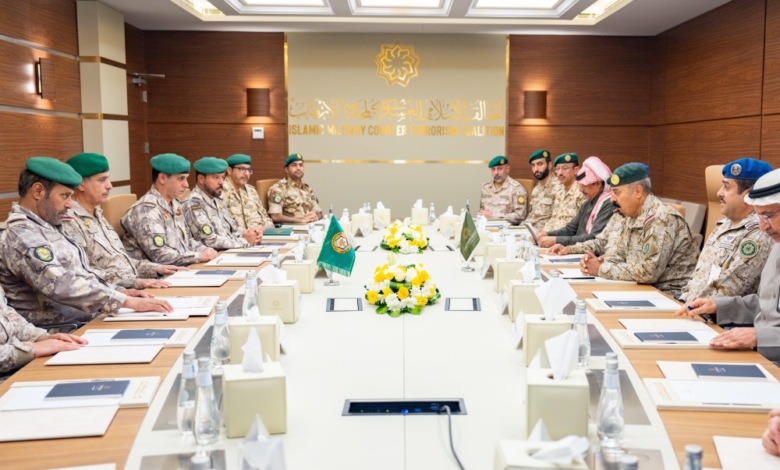
In a move aimed at unifying regional and international efforts to confront security challenges, the Secretary-General of the Islamic Military Counter Terrorism Coalition, Major General Pilot Staff Mohammed bin Saeed Al-Mughaidi, received at the Coalition’s headquarters in the Saudi capital, Riyadh, the Commander of the Unified Military Command of the Cooperation Council for the Arab States of the Gulf, Major General Staff Abdulaziz bin Ahmed Al-Balawi, and his accompanying delegation.
Dimensions of the visit and its strategic importance
This official visit comes at a crucial time, as the region witnesses intensive efforts to strengthen joint defense and security systems. Its significance stems from the fact that it brings together two important military umbrellas: the first is the Islamic Military Counter Terrorism Coalition, established at the initiative of the Kingdom of Saudi Arabia in December 2015, comprising 41 Islamic countries with the aim of coordinating efforts to combat extremism; the second is the Unified Military Command, which represents the joint defense arm of the Gulf Cooperation Council (GCC) states, reflecting the desire of both parties to create operational and intelligence integration.
A comprehensive approach to combating terrorism
The meeting reviewed the fundamental pillars upon which the work of the Islamic Alliance is based, which go beyond the traditional concept of military confrontation. It highlighted a comprehensive methodology based on four key integrated areas:
- The intellectual field: It aims to dismantle extremist arguments and confront them with sound legal and intellectual arguments.
- The media field: It focuses on combating terrorist propaganda and preventing the exploitation of digital platforms to spread hatred.
- Combating the financing of terrorism: by drying up the sources of financial support and cooperating with international bodies to cut off the lifeline to terrorist organizations.
- The military field: This includes security coordination and joint training to raise combat readiness.
Strengthening institutional work and exchanging experiences
During the field visit, the Gulf delegation was briefed on the advanced infrastructure of the Alliance headquarters, including the operational mechanisms of the Information Situation Assessment Center, a key hub for data analysis and monitoring of potential threats. The delegation also reviewed the training and development programs offered by the Alliance to national personnel in member states, as well as the specialized initiatives designed to enhance the capabilities of security agencies.
The future of joint security cooperation
At the conclusion of the visit, Major General Al-Mughaidi emphasized that this meeting represents a fundamental step in building strong bridges of cooperation with the Gulf military systems. Both sides affirmed the necessity of continued coordination to consolidate security and stability, noting that unifying efforts and exchanging intelligence and field expertise is the best way to confront growing threats, thus serving international peace and security and fulfilling the aspirations of the region's peoples to live in safety and lasting stability.