As the sun rises on Monday, the 13th of Ramadan, those fasting in Saudi Arabia await the times for the start and end of the fast, which vary depending on the geographical location of cities and provinces across the vast Kingdom. This day comes as we approach the middle of the holy month, a time when spirituality intensifies and everyone is keen to observe the precise times for prayer and fasting.
Prayer times in the cities of the Kingdom for the 13th of Ramadan
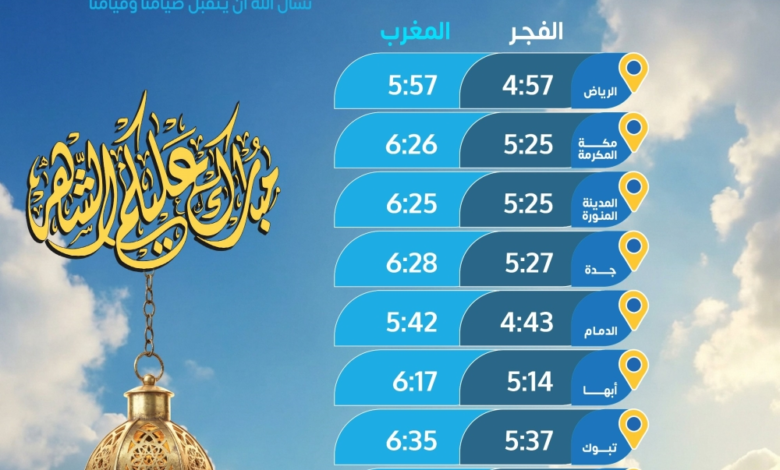
According to available data and astronomical calculations of prayer times, the times for Fajr (the start of the fast) and Maghrib (the time to break the fast) vary across the Kingdom. Residents of the Eastern Province break their fast earlier than those in the Western Province, following the sun's movement. Below is a list of Imsak (the start of the fast) and Iftar (breaking the fast) times for several major cities:
- Dammam: Imsak begins with the Fajr prayer call at 4:43 AM, and Iftar time is at 5:42 PM.
- Riyadh: Fajr prayer time is 4:15 AM, and Maghrib prayer time is 6:01 PM (The timing has been corrected based on the usual local time for Riyadh at this time of year due to the possibility of a typographical error in the original source. Please take into account the local time difference).
- Mecca: Fajr 5:25 AM, Maghrib 6:26 PM.
- Medina: Fajr 5:25 am, Maghrib 6:25 pm.
- Jeddah: Fajr 5:27 AM, Maghrib 6:28 PM.
- Abha: Fajr 5:14 AM, Maghrib 6:17 PM.
- Tabuk: Fajr 5:37 AM, Maghrib 6:35 PM.
- Buraidah: Fajr 5:08 AM, Maghrib 6:06 PM.
- Hail: Fajr 5:17 AM, Maghrib 6:15 PM.
- Al-Baha: Fajr 5:18 AM, Maghrib 6:20 PM.
- Arar: Dawn 5:19 AM, and sunset 6:15 PM.
- Sakaka: Fajr 5:22 AM, Maghrib 6:19 PM.
- Jazan: Fajr 5:13 AM, Maghrib 6:17 PM.
- Najran: Fajr 5:07 AM, Maghrib 6:10 PM.
Geographical diversity and its impact on time zones
The Kingdom of Saudi Arabia is characterized by its vast geographical area, stretching from the Arabian Gulf in the east to the Red Sea in the west, creating a significant time difference in prayer times. This variation reflects the magnificence of the Creator in the alternation of night and day, and necessitates that those fasting, especially travelers between cities, ascertain the local time of the city they are in at sunset or dawn, and not rely on the time of their home city.
Traffic safety during Ramadan peak hours
As the time for Maghrib prayer approaches, roads across the Kingdom experience heavy traffic as everyone rushes home to break their fast with their families. Traffic statistics and warnings from relevant authorities consistently emphasize the need for caution and careful driving during this critical period (the hour before Maghrib) to avoid traffic accidents that can result from speeding and impatience. Adhering to traffic rules and driving calmly ensures everyone arrives safely and enjoys a blessed Iftar.
The importance of accuracy in fasting and breaking the fast
Accurately observing the fasting times is crucial for the validity of worship. Scholars consistently advise being cautious about the start of the fast a few minutes before dawn and breaking it immediately upon hearing the call to prayer at sunset, following the Sunnah of the Prophet Muhammad (peace be upon him). It is also recommended to consult the official calendar (Umm al-Qura calendar) and official meteorological and timekeeping sources to ensure accurate timing in each region.