With the dawn of the second day of Ramadan, those fasting in Saudi Arabia renew their search for accurate prayer times, specifically the times for Imsak (the start of the fast) and Iftar (the breaking of the fast), to ensure they perform their religious duties at the correct times. This heightened focus comes amidst the spiritual atmosphere prevailing in the Kingdom's cities, where prayer times vary by only a few minutes from one region to another due to the country's vast geographical expanse.
Prayer times in the cities of the Kingdom for Thursday
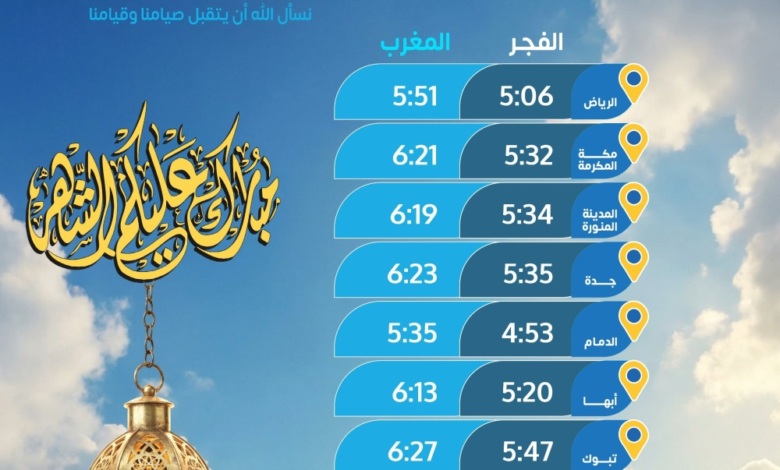
According to data issued by official authorities and the National Center for Meteorology, the times for Fajr (the start of fasting) and Maghrib (the time of breaking the fast) prayers for Thursday, the 2nd of Ramadan, in the major cities of the Kingdom are as follows:
- Dammam: Fajr 4:53 AM - Maghrib 5:35 PM.
- Riyadh (the capital): Fajr 5:06 AM – Maghrib 5:51 PM.
- Mecca: Fajr 5:32 AM - Maghrib 6:21 PM.
- Medina: Fajr 5:34 AM – Maghrib 6:19 PM.
- Jeddah: Fajr 5:35 AM - Maghrib 6:23 PM.
- Abha: Fajr 5:20 am - Maghrib 6:13 pm.
- Tabuk: Fajr 5:47 AM - Maghrib 6:27 PM.
- Buraidah: Fajr 5:17 AM - Maghrib 6:00 PM.
- Hail: Fajr 5:27 AM - Maghrib 6:08 PM.
- Al-Baha: Fajr 5:25 am - Maghrib 6:16 pm.
- Arar: Dawn 5:30 AM - Sunset 6:07 PM.
- Sakaka: Fajr 5:33 AM – Maghrib 6:11 PM.
- Jazan: Fajr 5:19 AM - Maghrib 6:14 PM.
- Najran: Fajr 5:13 AM - Maghrib 6:07 PM.
The importance of accuracy in timing
Knowing the precise prayer times is of paramount importance to Muslims, not only for determining when to begin fasting, but also for organizing their daily schedules for worship, Quran recitation, and Taraweeh prayers. The variation in prayer times between cities in the Eastern Province (such as Dammam) and cities in the Western Province (such as Jeddah and Mecca) reflects the vast geographical expanse of the Kingdom, with Iftar (the breaking of the fast) occurring in the eastern regions significantly earlier than in the western regions.
The role of the National Center for Meteorology
In a related development, the National Center for Meteorology announced its readiness for the holy month of Ramadan, monitoring weather conditions and providing regular reports relevant to those fasting and performing Umrah, particularly in Mecca and Medina, which experience a high volume of visitors during this blessed month. Monitoring weather forecasts helps those fasting take necessary precautions when going out to perform prayers or Umrah.
Experts always advise following the official calendar (Umm Al-Qura calendar) adopted in the Kingdom to ensure the accuracy of prayer times, taking into account the time differences for residents of villages and centers affiliated with major cities.