With the sunrise on Tuesday, the fourteenth of the blessed month of Ramadan, fasting Muslims in the Kingdom of Saudi Arabia continue to perform their religious duty in an atmosphere of high faith and spirituality, as the holy month reaches its midpoint and the nights of forgiveness begin to pass, which increases the Muslims’ keenness to be precise in the timing of acts of worship, especially the times of fasting and breaking the fast.
In this context, knowing the precise timing of the Fajr (dawn) and Maghrib (sunset) prayers is of paramount importance for the validity of the fast, as the timings vary across the vast Kingdom due to each city's geographical location. The times for Imsak (pre-dawn meal) and Iftar (breaking the fast) have been observed in several major cities today. Residents of the Eastern Province break their fast at the earliest, while the time gradually decreases as one moves westward.
Imsak and Iftar times for Tuesday, the 14th of Ramadan
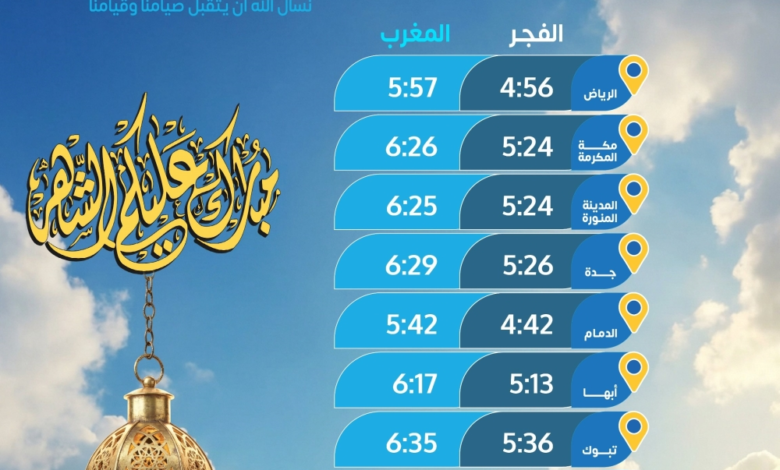
According to astronomical data and announced local times, the times for the Fajr (pre-dawn) and Maghrib (breaking the fast) prayers in a number of cities and governorates of the Kingdom are as follows:
- Dammam: Imsak begins at 4:42 AM, and Iftar time is at 5:42 PM.
- Riyadh: Fajr prayer time is 5:56 AM, and Maghrib prayer time is 5:57 PM.
- Mecca: The Fajr prayer call is at 5:24 AM, and the Maghrib prayer call is at 6:26 PM.
- Medina: Fajr 5:24 AM, Maghrib 6:25 PM.
- Jeddah: Fajr 5:26 AM, Maghrib 6:29 PM.
- Abha: Fajr 5:13 AM, Maghrib 6:17 PM.
- Tabuk: Fajr 5:36 AM, Maghrib 6:35 PM.
- Buraidah: Fajr 5:07 AM, Maghrib 6:07 PM.
- Hail: Fajr 5:16 AM, Maghrib 6:15 PM.
- Al-Baha: Fajr 5:17 am, Maghrib 6:20 pm.
- Arar: Dawn 5:18 AM, and sunset 6:16 PM.
- Sakaka: Fajr 5:21 AM, Maghrib 6:20 PM.
- Jazan: Fajr 5:13 AM, Maghrib 6:18 PM.
- Najran: Fajr 5:06 AM, Maghrib 6:11 PM.
The importance of accuracy in timing
The 14th of Ramadan is a special day as it marks the end of the second week of the holy month and the approach of the three nights of the full moon (Laylat al-Bid), during which increased acts of worship are highly recommended. Scholars consistently emphasize the importance of relying on the official calendar (Umm al-Qura calendar) and other reliable sources to determine the start of prayer times, given their direct connection to the validity of worship.
Weather conditions can sometimes affect the visual visibility of the new moon or true dawn. Therefore, relying on precisely calculated astronomical timings is the safest option for those fasting. The list above illustrates the natural time variations between the east, west, north, and south of the Kingdom, reflecting the vast geographical expanse of Saudi Arabia. This necessitates that travelers between cities pay attention to time differences to ensure they begin and end their fast at the correct Islamic times.