
The importance of knowing the times for fasting and breaking the fast in the last days of Ramadan
With the arrival of the last ten days of the blessed month of Ramadan, specifically on Monday, the 27th of Ramadan, Muslims in Saudi Arabia and throughout the Islamic world turn their attention to precisely determining prayer times. This day is considered of immense spiritual significance, as many hope to witness Laylat al-Qadr (the Night of Decree), which is better than a thousand months. Therefore, knowing the times for fasting and breaking the fast is not only for regulating eating and drinking times, but also for organizing the times allocated for worship, reciting the Quran, and performing night prayers and supplications.
Historical context and reliance on astronomical calculations
Historically, Muslims relied on direct visual observation to determine the times of dawn and sunset. With the advancement of astronomy and technology, Islamic countries, most notably Saudi Arabia, have adopted the Umm al-Qura calendar, considered one of the most accurate calendars globally for calculating prayer times. The National Center for Meteorology and other relevant authorities update this data daily to ensure the accuracy of the times for fasting and breaking the fast, thus facilitating the observance of Ramadan, the fourth pillar of Islam, with complete peace of mind and ease, and avoiding any confusion that might arise due to the vast geographical area of the Kingdom.
The local and social impact of breakfast times
Locally, the timing of Iftar (the breaking of the fast) plays a pivotal role in shaping the daily lives of citizens and residents in the Kingdom. Before the Maghrib prayer, the streets bustle with activity as everyone rushes home to break their fast with their families, strengthening social and familial bonds. Traffic authorities also intensify their efforts to manage traffic flow and prevent accidents during the pre-Iftar rush hour. Regionally and internationally, Muslim communities follow the prayer times of the Two Holy Mosques due to their deep spiritual connection to Mecca and Medina.
Schedule of Imsak and Iftar times for Monday, the 27th of Ramadan
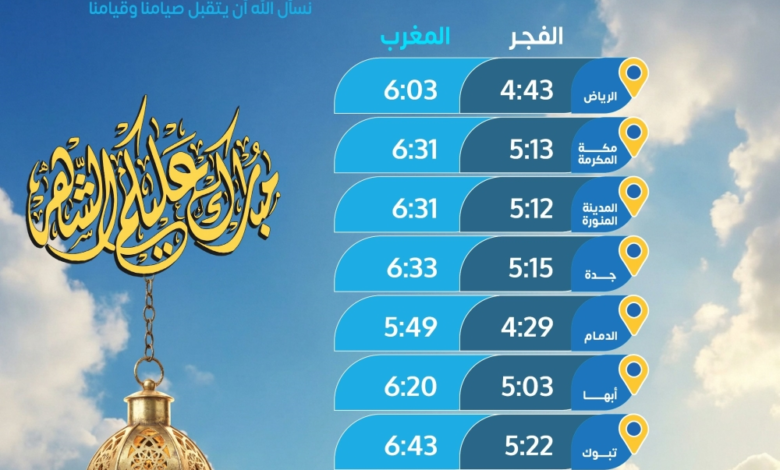
The National Center for Meteorology and relevant authorities have announced the times for Fajr (Imsak) and Maghrib (Iftar) prayers in various cities and regions of the Kingdom of Saudi Arabia for Monday, the 27th of Ramadan. The times are as follows:
- Riyadh: Imsak (pre-dawn meal) is at 4:43 AM, and Iftar (breaking the fast) is at 6:06 PM.
- Makkah Al-Mukarramah: Imsak (pre-dawn meal) is at 5:13 AM, and Iftar (breaking the fast) is at 6:31 PM.
- Madinah: Imsak (pre-dawn meal) is at 5:12 AM, and Iftar (breaking the fast) is at 6:31 PM.
- Jeddah: Imsak (pre-dawn meal) is at 5:18 AM, and Iftar (breaking the fast) is at 6:32 PM.
- Dammam: Imsak (pre-dawn meal) is at 4:29 AM, and Iftar (breaking the fast) is at 5:49 PM.
- Abha: Imsak (pre-dawn meal) is at 5:03 AM, and Iftar (breaking the fast) is at 6:20 PM.
- Tabuk: Imsak (pre-dawn meal) is at 5:22 AM, and Iftar (breaking the fast) is at 6:43 PM.
- Buraidah: Imsak (pre-dawn meal) is at 4:53 AM, and Iftar (breaking the fast) is at 6:14 PM.
- Hail: Imsak (pre-dawn meal) is at 5:02 AM, and Iftar (breaking the fast) is at 6:23 PM.
- Al-Baha: Imsak (pre-dawn meal) is at 5:07 AM, and Iftar (breaking the fast) is at 6:24 PM.
- Arar: Imsak (pre-dawn meal) is at 5:02 AM, and Iftar (breaking the fast) is at 6:24 PM.
- Sakaka: Imsak (pre-dawn meal) is at 5:06 AM, and Iftar (breaking the fast) is at 6:28 PM.
- Jazan: Imsak (pre-dawn meal) is at 5:03 AM, and Iftar (breaking the fast) is at 6:20 PM.
- Najran: Imsak (pre-dawn meal) is at 4:57 AM, and Iftar (breaking the fast) is at 6:14 PM.
conclusion
In conclusion, all those fasting are advised to be mindful of the slight time differences that may occur between the governorates and villages within each major region. We ask God to accept everyone's fasting, prayers, and good deeds during these blessed days of Ramadan, and to bring it back to the Muslim Ummah with goodness, prosperity, and blessings.