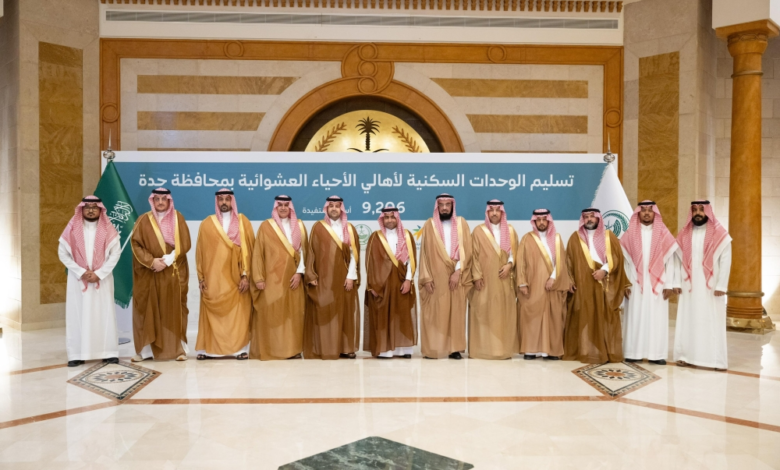
Housing units delivered to 9,000 families from Jeddah's informal settlements

In a move that reflects the wise leadership’s commitment to providing a decent life for citizens, and with the direct guidance of His Royal Highness Prince Saud bin Mishaal bin Abdulaziz, Deputy Governor of Makkah Region and Chairman of the Main Committee for the Removal of Slums in Jeddah Governorate, the procedures for handing over housing units to beneficiaries from the neighborhoods that were subject to removal and development have been completed.
The Deputy Governor of Makkah Region, Dr. Mohammed bin Salem Al-Balahid, handed over the housing units to their beneficiaries at the Governorate headquarters in Jeddah, in the presence of the Deputy Minister of Municipalities and Housing for Housing Supply and Real Estate Development, Abdulrahman Al-Tawil. Official statistics revealed that the number of families benefiting from housing services reached 9,206, representing a significant achievement in addressing the impact of slum clearance.
Context of the Jeddah Development Project and its Strategic Objectives
This important event is an integral part of the massive national project to reorganize and develop informal settlements in Jeddah. Launched with significant government support, this project primarily aims to address visual pollution and improve the city's urban landscape, befitting Jeddah's status as the gateway to the Two Holy Mosques and a major economic and tourist hub on the Red Sea coast.
The project’s objectives were not limited to the urban aspect alone, but focused fundamentally on the humanitarian and social aspect, as the state sought from the first day of announcing the demolitions to reassure the residents that there were alternative plans and immediate and sustainable housing solutions, especially for families on social security and those who do not have legal deeds, to ensure that they would not be harmed by the development operations.
Alignment with the Kingdom's Vision 2030
This step falls within the objectives of the Kingdom's Vision 2030, specifically the Quality of Life Program and the Housing Program. Relevant authorities are working in complete harmony to increase homeownership rates among citizens and provide safe and organized residential environments with all necessary services and public facilities, replacing the informal settlements that lacked proper urban planning and suffered from inadequate infrastructure.
The delivery of over 9,000 housing units reflects the high credibility of government agencies in fulfilling their promises and their commitment to the social stability of families. This achievement also paves the way for transforming Jeddah into a world-class destination with standardized specifications, where informal settlements will be replaced with developmental and urban projects that contribute to increasing the gross domestic product and providing promising opportunities, while preserving the social fabric and caring for the most vulnerable groups.