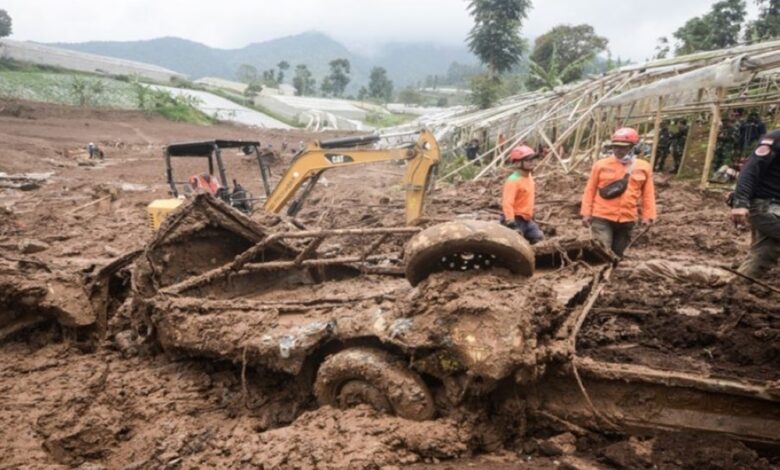

Indonesian authorities announced on Saturday that the death toll from the landslide that struck the main island of Java about a week ago has risen to 53, after more bodies were recovered from under the rubble, while rescue teams are still racing against time to find 10 people who are still missing.
Details of the disaster in Pasirlango village
A devastating landslide struck Pasirlango village, southeast of Jakarta, following prolonged heavy rainfall that saturated the soil and caused a sudden collapse. The natural disaster caused widespread destruction, damaging or destroying more than 50 homes and forcing approximately 650 people to flee their homes in search of safer shelter.
Rescue efforts and field challenges
Thousands of rescue workers, supported by army and police forces and local volunteers, are continuing their arduous search through the mud and rubble. The head of the local search and rescue agency, Adi Dian Permana, stated that field teams had recovered and identified 53 bodies as of Saturday, up from the previous count of 44 victims.
Permana noted that the relatively improved weather conditions had facilitated search operations in recent hours, emphasizing that efforts would continue until the remaining ten missing individuals were found. Meanwhile, the Indonesian Navy reported that one of its units was damaged, with 23 personnel trapped while conducting training exercises in the area at the time of the collapse.
The geographical and climatic context of disasters in Indonesia
Comprised of thousands of volcanic islands, Indonesia is one of the world's most disaster-prone countries. Located within the Pacific Ring of Fire, its geological features make it susceptible to earthquakes, volcanic eruptions, landslides, and floods.
These incidents occur seasonally, with the rainy season typically lasting from October to March. The heavy tropical rainfall further weakens the soil, particularly in mountainous and hilly areas where villages and residential communities are located, keeping residents on constant alert during these months.
Environmental factors and the impact of deforestation
Besides natural factors, human activity plays a crucial role in exacerbating these disasters. The Indonesian government has repeatedly pointed out that illegal logging and deforestation directly contribute to floods and landslides. Late last year, the island of Sumatra experienced similar disasters that claimed the lives of approximately 1,200 people and displaced more than 240,000, with authorities attributing a significant portion of the cause to the degradation of vegetation cover.
It is scientifically known that forests act as natural barriers; tree roots absorb rainwater and stabilize the soil, reducing the risk of erosion. However, with the continued encroachment on forests for agriculture or urban expansion, the soil loses its cohesion, turning normal seasonal rains into humanitarian disasters, as recently occurred on Siau Island, where flash floods claimed 16 lives.