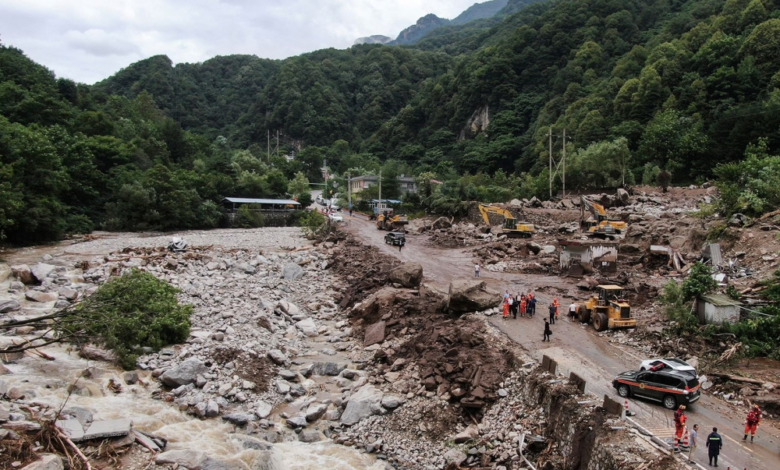
Indonesian authorities announced on Wednesday a tragic rise in the death toll from the landslide that struck West Bandung in Java last Saturday, with the number of confirmed fatalities reaching 38, while rescue teams race against time to search for dozens of missing people under the rubble and mud.
This disaster was caused by heavy rains in the region, which led to massive landslides that buried homes in two villages about 25 kilometers from Bandung, the country’s fourth most populous city.
Details of search and rescue operations
Adi Dian Permana, head of the Bandung search and rescue agency, stated in an official statement that field teams had recovered and identified 38 bodies by Wednesday afternoon. He noted that official lists confirm 27 other people are still missing, suggesting the death toll could rise.
Rescue teams face significant challenges on the ground, as personnel are advancing with extreme caution due to the unstable terrain and water saturation of the soil with continued rainfall, which complicates the access of heavy machinery to some critical points.
Evacuation of residents and material damage
The disaster caused widespread destruction, with more than fifty homes either completely destroyed or severely damaged. In response to the ongoing risks, authorities evacuated more than 650 residents from the affected area in western Bandung to temporary shelters to ensure their safety.
In a related context, the Indonesian Navy revealed that the landslides not only damaged civilians, but also trapped 23 soldiers who were conducting military exercises in the area, in preparation for their deployment on the border between Indonesia and Papua New Guinea, adding another complication to the ongoing rescue operations.
The geographical and climatic context of Indonesia
Indonesia, a vast archipelago of more than 17,000 islands, is one of the world's most disaster-prone countries. Located within the Pacific Ring of Fire, the country is characterized by rugged, mountainous, and volcanic terrain. During the monsoon season, which typically runs from October to March, the fertile but fragile volcanic soil becomes saturated with water, making the sloping areas highly susceptible to landslides.
Impact of deforestation and environmental change
This incident has once again highlighted the country's pressing environmental issues. The Indonesian government and environmental experts have repeatedly pointed to the detrimental role of deforestation and unplanned urban expansion in exacerbating floods and landslides. The loss of vegetation weakens soil cohesion, making it more susceptible to erosion during heavy rainfall.
It is worth noting that this disaster brings to mind the tragedy that occurred on the island of Sumatra late last year, where similar floods and landslides killed about 1,200 people and displaced more than 240,000, which calls for strengthening disaster management and environmental protection strategies in the region.