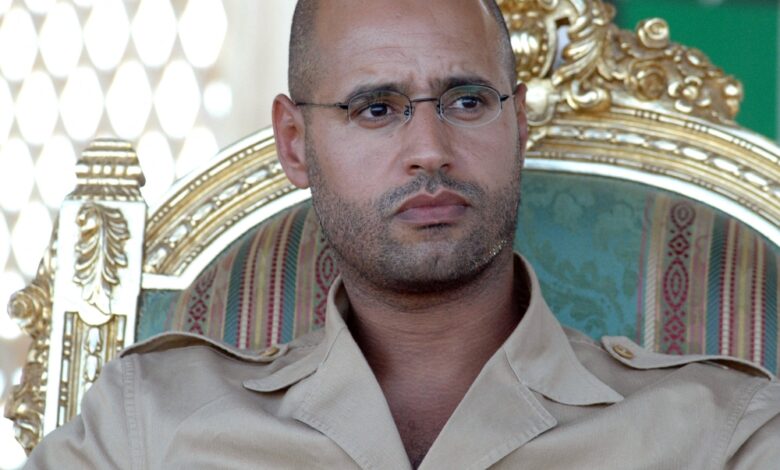
The Public Prosecutor's Office is investigating the killing of Saif al-Islam Gaddafi: Full details

The Public Prosecutor's Office in the Libyan capital, Tripoli, announced on Wednesday the opening of an official and extensive investigation into the killing of Saif al-Islam Gaddafi , the son of the late Libyan leader Muammar Gaddafi, confirming that the death resulted from a direct gunshot wound.
The Attorney General’s office stated in an official statement that a specialized investigation team comprising prosecutors, forensic doctors and criminal experts was dispatched to the city of Zintan , where the body of Saif al-Islam, who for many years had been seen as the likely political heir to his father, was examined.
Details of the incident and the criminal report
The statement, published on the Public Prosecutor's Office's official Facebook page, clarified that the forensic medical examination confirmed the victim suffered fatal gunshot wounds. The Public Prosecutor's Office affirmed the immediate commencement of necessary criminal procedures to identify the perpetrators and suspects in order to prosecute them and bring them to justice.
As of now, no accurate information is available regarding the funeral arrangements or the place where Gaddafi’s son will be buried, amid a state of anticipation on the Libyan street.
Defense narrative: Commandos carried out the attack
In a related development, Marcel Ceccaldi, the French lawyer representing Saif al-Islam Gaddafi, told AFP that his client was killed inside his residence in the city of Zintan. The lawyer indicated that the operation was carried out by a "commando group of four," noting that their identities and affiliations remain unknown.
From reform to "bloodbaths": A controversial journey
Saif al-Islam is a pivotal and controversial figure in modern Libyan history. Before the outbreak of the February 17, 2011 revolution, he had for years sought to present himself as a moderate reformer, leading initiatives to resolve contentious issues with the West. However, this image completely collapsed with the outbreak of the popular uprising, as he appeared in televised speeches threatening protesters with "bloodbaths" and warning of civil war, making him a prime target for the revolutionaries.
Following the fall of his father's regime and his death in 2011, Saif al-Islam was captured by an armed group in the city of Zintan (145 km southwest of Tripoli), where he remained for years. During this period, he was tried in absentia in Tripoli and sentenced to death in 2015 for war crimes and the repression of protesters. He remains wanted by the International Criminal Court on an outstanding arrest warrant.
The political comeback and the complex landscape
The case of Saif al-Islam took a dramatic turn when the Abu Bakr al-Siddiq Brigade in Zintan refused to hand him over and announced his release in 2017, citing a general amnesty law issued by the parliament in eastern Libya. Since then, he had largely disappeared from public view, making only rare appearances, before resurfacing in 2021 by submitting his candidacy papers for the presidential elections in Sabha, relying on a popular base of supporters of the former regime.
This incident comes at a time when Libya is suffering from a deep political divide and an ongoing power struggle. Two rival governments are vying for control: the internationally recognized Government of National Accord in Tripoli, headed by Abdul Hamid Dbeibah, and a parallel government in the east supported by the parliament and Field Marshal Khalifa Haftar. The killing of Saif al-Islam is expected to further complicate the already tense political landscape, given his symbolic importance to a segment of the Libyan population and the impact his absence will have on the balance of power and tribal alliances in the country.