Iran's women's national team and the national anthem: The secret of the military salute

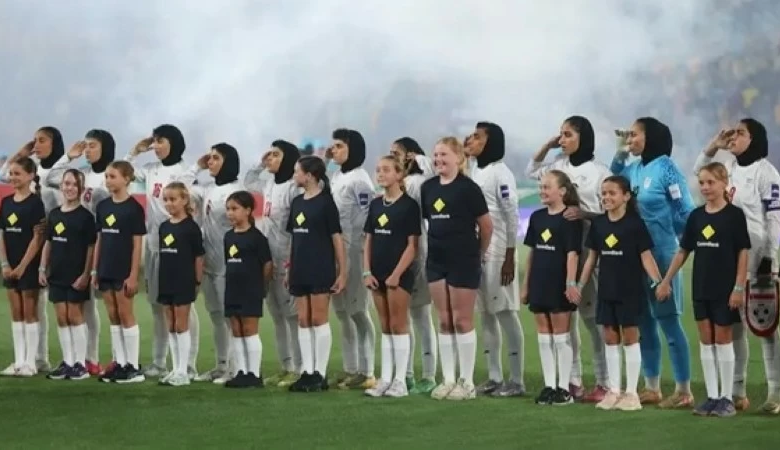
The Iranian women's national team sparked widespread controversy in sporting and political circles during their participation in the Asian Cup after the players surprised the audience by performing a military salute during the national anthem before their match against Australia. This scene was in stark contrast to their behavior in the previous match, raising numerous questions about the nature of the pressures the team might be facing.
Contradictory stances: from silence to a military salute
In the match preceding Australia's game against South Korea, the players chose to stand silently during the national anthem, a move interpreted as a silent protest or show of solidarity with domestic issues. This coincided with escalating military tensions in the region following airstrikes by the United States and Israel. However, the scene changed dramatically in the following match, with the players singing the anthem and refraining from the military salute, without any official explanation for this sudden shift in behavior.
Background to the pressures and security interventions
Media reports and informed sources indicate that this change was not a spontaneous decision by the players. Iran International's correspondent in Australia reported strong indications that the team received strict instructions to sing the national anthem and perform the military salute to demonstrate loyalty under the current circumstances. Reports also noted the presence of a security team accompanying the national team throughout the tournament, reinforcing the theory that the players were pressured by official authorities to ensure that the silence witnessed in the first match was not repeated.
Historical context: Sport at the heart of politics
This is not the first such incident in the history of modern Iranian sports; it recalls the scenario experienced by the Iranian men's national team during the 2022 World Cup in Qatar. At that time, the players refused to sing the national anthem in their opening match as a show of solidarity with the popular protests in their country, before returning to sing it in subsequent matches amidst reports of immense political and media pressure. This pattern illustrates how international stadiums can become arenas for political expression, and how authorities seek to control the public image of their sports delegations.
The impact of the crisis on artistic performance
Marzieh Jafari emphasized that the team had come to Australia solely for football, expressing her disapproval of the war by saying, "No one likes war or wants it to happen." Striker Sara Didar also spoke with evident emotion about the difficulty of playing away from her family given the challenging circumstances in the country.
On the technical level, it seems that psychological pressures have affected the team's performance, as the national team suffered a heavy 4-0 defeat against Australia on Thursday, which puts the team in a critical situation and makes the upcoming match against the Philippines a decisive match to maintain hopes of qualifying for the knockout stages.