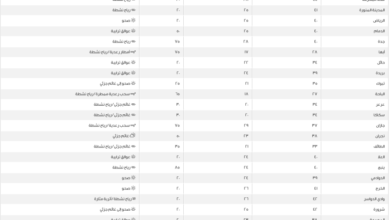

The National Center for Meteorology in Saudi Arabia issued its daily weather forecast for Wednesday, indicating continued weather fluctuations across large parts of the country. The center predicted a continued chance of thunderstorms, potentially moderate to heavy, accompanied by hail and strong surface winds, over the highlands of Jazan, Asir, and Al-Baha regions, extending to parts of the Makkah region.
The effect of active winds and raised dust
Conversely, the impact of active winds stirring up dust and sand continues, reducing horizontal visibility in parts of these regions, in addition to its noticeable effect on the Eastern Province, Riyadh, Medina, and Tabuk. The center warned that visibility may reach near zero in parts of the Al-Jawf and Northern Borders regions, necessitating caution, especially for those using highways.
The climatic context of weather fluctuations in the Kingdom
These weather fluctuations are part of the typical climatic pattern in Saudi Arabia during the transitional periods between seasons, as the country is affected by the convergence of different air masses. The southern and western regions, with their mountainous terrain, are more prone to the formation of cumulonimbus clouds due to high daytime temperatures and the availability of moisture from the Red Sea. Meanwhile, the northern and central regions are affected by drier air masses, leading to increased surface wind activity and the formation of dust storms, a prominent climatic feature of the Arabian Peninsula.
Importance and expected local impacts
These weather phenomena have direct impacts on daily life. Heavy rainfall in the southwestern highlands increases the likelihood of flash floods in valleys and ravines, posing a risk that necessitates continuous monitoring of Civil Defense warnings. Dust storms significantly affect public health, particularly for those with asthma and respiratory conditions, and also disrupt land and air transportation due to reduced visibility. Relevant authorities, such as the Ministry of Health and Civil Defense, are working to raise their level of preparedness to deal with any emergencies that may arise from these weather conditions.
The situation in the Red and Arabian Seas
Red Sea: Surface winds will be northwesterly to northerly in the northern and central parts, and northwesterly to westerly in the southern part, with speeds ranging from 10 to 25 km/h. Wave height will be between half a meter and one meter, and the sea state will be slight.
Arabian Gulf: Surface winds are northwesterly to westerly at a speed of 10-25 km/h, with wave heights ranging between half a meter and one meter, making the sea state slightly choppy.
Warnings specific to the Eastern Province
The National Center for Meteorology has issued a warning of active winds and blowing dust in parts of the Eastern Province, starting at 9:00 AM and continuing until 9:00 PM. This warning covers the governorates of Jubail, Khobar, Dammam, Dhahran, Qatif, and Ras Tanura, where wind speeds may reach 49 km/h, accompanied by reduced visibility and high waves. The warning also includes the areas of Hafr Al-Batin, Khafji, Nairyah, and Qaryat Al-Ulya, with horizontal visibility expected to decrease to 3-5 kilometers.