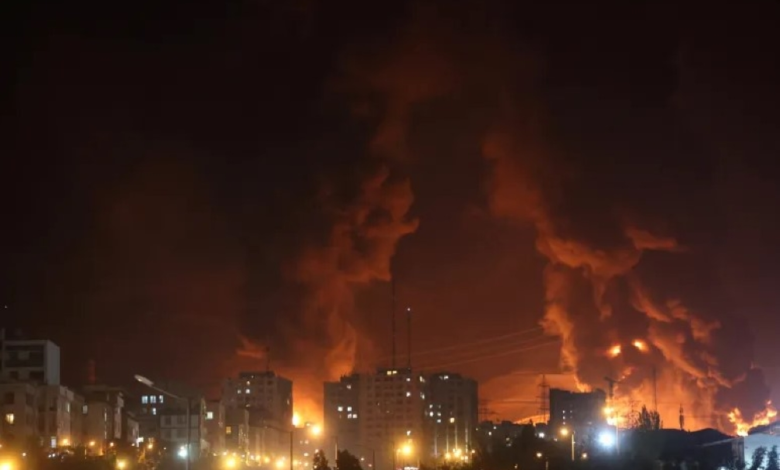

Military tensions in the Middle East have escalated to unprecedented levels, with the Israeli military announcing on Friday that it had carried out a series of airstrikes targeting more than 400 sites inside Iran, marking the seventh day of the ongoing military operations. This announcement signals a significant shift in the conflict, as the strikes focused on military infrastructure in western Iran.
Details of military targets
In an official statement, the Israeli military explained that its aircraft dropped precision-guided munitions on hundreds of Iranian regime targets. The list of declared targets included mobile and fixed ballistic missile launchers, as well as strategic drone storage facilities, which Israel considers a direct threat to its national security. Military spokesman Nadav Shoshani emphasized that the operations adhered to international law and targeted only military capabilities to neutralize the threat.
The Iranian narrative: heavy civilian casualties
In contrast, Tehran presented a completely different account from Tel Aviv's, stating that the bombing targeted populated areas. The Iranian news agency Mehr quoted government spokesperson Fatemeh Mohajerani as providing preliminary damage statistics since the start of the campaign last week, confirming that 390 residential units, 528 commercial centers, and 13 medical facilities had been damaged, exacerbating the humanitarian situation.
State television and Iranian media outlets have broadcast videos showing destruction in residential neighborhoods in the western city of Ilam, as well as in the capital Tehran, including severe damage to a building in the popular Azadi sports complex.
Context of the conflict and history of the confrontation
This current escalation cannot be separated from the historical context of the protracted conflict between the two sides, which has been waged for years through what is known as a "shadow war" or via regional proxies. However, recent developments indicate a break from traditional rules of engagement and a move toward direct and open confrontation. This shift reflects the desire of both sides to impose new deterrence equations, with Israel seeking to undermine Iran's missile capabilities, while Tehran attempts to demonstrate its resilience and ability to retaliate.
Expected regional and international repercussions
The continuation of this conflict raises serious concerns within the international community about the region sliding into a full-blown regional war that could draw in other parties. Attention is also focused on the impact of these operations on global energy markets, given Iran's strategic position in the oil market and the Strait of Hormuz. Observers fear that targeting civilians and infrastructure could lead to waves of displacement or exacerbate humanitarian crises, necessitating urgent diplomatic action from major powers to de-escalate the situation and prevent it from spiraling out of control.