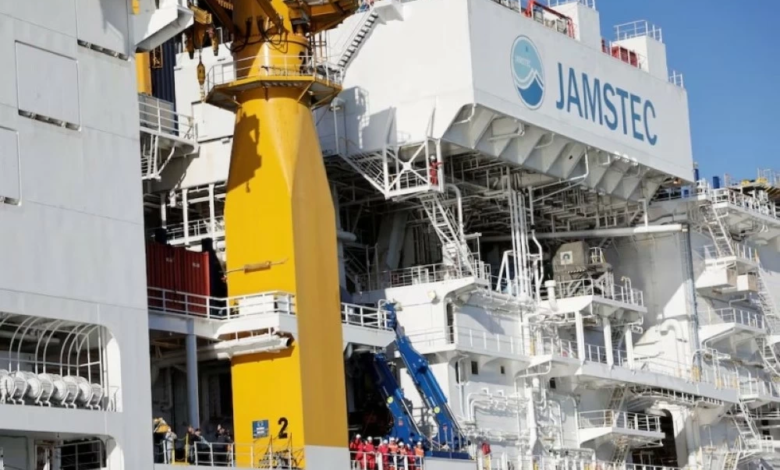

In a strategic move aimed at redrawing the global resource map, the giant Japanese research and exploration vessel Chikyu set sail today (Monday) from the port of Shimizu in Shizuoka Prefecture. Its destination is the deep waters near the remote Minamitori Island in the Pacific Ocean, located about 1,900 kilometers southeast of Tokyo.
This mission comes as part of a decisive Japanese move to secure national supply chains in the face of escalating geopolitical tensions.
An unprecedented technological mission in the deep ocean
The month-long mission aims to conduct the world's first-ever continuous extraction of rare-earth mud. The challenge lies in the extreme depth at which the equipment will operate, reaching up to 6 kilometers below the sea surface, before the mud is lifted directly onto the ship for initial processing and analysis.
The Chikyo is considered a jewel of Japanese marine technology, as it was specially designed to reach the deep layers of the earth, and Tokyo is counting on it to prove the feasibility of deep-sea mining, a field that is still fraught with technical and economic challenges.
Strategic Importance: 21st Century Oil
This step is of paramount importance in light of the global race towards clean technology. Rare earth metals are considered the "new oil" of the 21st century, as they are essential components in the manufacture of magnets for electric vehicle motors, smartphone screens, wind turbines, as well as vital components in advanced military industries and missile guidance systems.
Through this project, Japan aims to reduce its structural dependence on China, which currently dominates the processing and production of the majority of these elements globally. Shuichi Ishii, head of the government-backed project, said, “After seven years of continuous preparation, we are finally beginning the actual testing phase. It’s a very moving feeling, and if the project succeeds, it will be of great importance in diversifying Japan’s sources of rare earth minerals.”.
Background to the conflict: Lessons from the 2010 crisis
This Japanese move cannot be separated from the tense historical and political context with Beijing. The memory of the 2010 incident remains fresh in the minds of Japanese policymakers, when China suspended rare earth exports to Japan following a diplomatic dispute over islands in the East China Sea and the detention of a Chinese fishing vessel's captain. That incident served as a wake-up call, prompting Tokyo to reduce its reliance on Chinese imports from 90% to approximately 60% by investing in mines in Australia and enhancing recycling technologies.
However, Japan remains almost entirely dependent on China for some rare and highly sensitive “heavy components” for hybrid and electric vehicle engines, making it vulnerable to any future political upheavals.
Recent escalation of trade tensions
The expedition comes at a critical time, as tensions have recently escalated after Beijing last week imposed a ban on exports to Japan of certain dual-use (civilian and military) materials, including critical metals such as gallium and germanium. Unofficial reports suggest that China has already begun tightening restrictions on rare earth metal exports to Japan, a move seen as retaliation for Tokyo and Washington's limitations on China's access to advanced chip technologies.
A huge investment and a forward-looking vision
The Japanese government has allocated a huge budget for this national project, having started investing around 40 billion yen (equivalent to $250 million) since 2018. The ship "Chikyo" - which carries 130 sailors and researchers - is expected to return on February 14, 2026.
If this experiment proves successful, Japan plans to conduct a large-scale mining trial in February 2027, paving the way for a gradual shift towards commercial production in subsequent years. While high costs were previously a barrier to deep-sea mining, national economic security imperatives now justify these expenses to ensure Japan's decision-making independence from external pressures.