
In a strategic move reflecting the Kingdom of Saudi Arabia's commitment to environmental protection and sustainability, the National Afforestation Program a significant environmental achievement: the creation of a detailed plant map of the Jazan region. This map includes more than 165 native plant species suitable for the region's diverse environment. This announcement directly supports afforestation based on sound scientific principles, effectively contributing to the goals of the Saudi Green Initiative and the Kingdom's ambitious Vision 2030.
Unique geographical diversity and environmental richness
The Jazan region boasts an exceptional geography that makes it one of the richest areas in the Kingdom in terms of biodiversity. From the coastal plains stretching along the Red Sea, through the expansive Tihama region, to the towering peaks of the Sarawat Mountains, diverse climatic environments exist, allowing for the growth of a wide array of plant life. The program emphasized that this unique environmental diversity fosters a vast plant life that is distributed with remarkable flexibility, covering valleys, plateaus, meadows, and even rocky slopes and cliffs, making Jazan a microcosm of plant diversity in the Arabian Peninsula.
This natural expanse extends beyond the mainland to include scattered islands and salt flats, enhancing the chances of success for afforestation projects in diverse environments, whether harsh or temperate. This natural richness is a fundamental pillar for supporting environmental conservation efforts and combating desertification, ensuring the sustainability of natural resources for future generations.
Strategic importance and expected impact
This step is of paramount importance beyond the local level. Nationally, this list contributes to accelerating afforestation efforts to reach the goal of planting 10 billion trees in the coming decades, the primary objective of the Saudi Green Initiative. Regionally and internationally, preserving vegetation in a vital area like Jazan contributes to strengthening ecological balance, reducing carbon emissions, and combating climate change, which threatens the world.
Official data revealed a detailed classification of plant species, with the Anacardiaceae, Palmaceae, Compositae, Leguminosae, Ziziphus spina-christi, and Salvadora persica species topping the list. The list also included species of high ecological value such as Oleander, Amaranthaceae, Oliveaceae, and Lamiaceae, reflecting the region's rich biodiversity.
A golden list of sustainable species
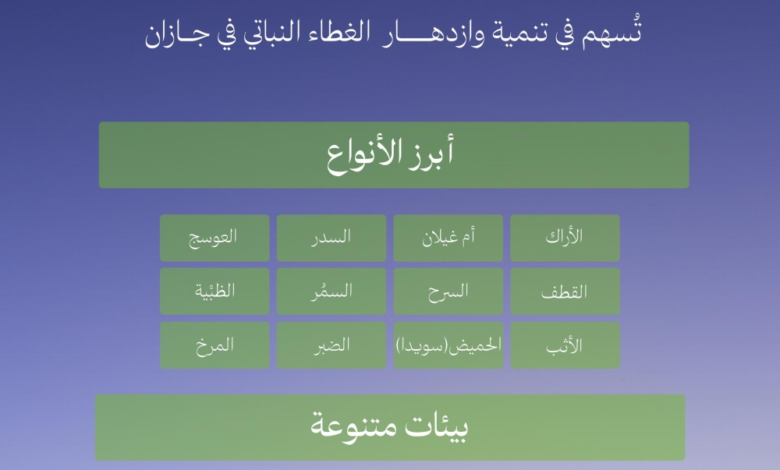
The program showcased the most suitable plant species for afforestation, ranging from towering trees and perennial shrubs to annuals, succulents, and bulbs. It identified a "golden list" of the most suitable species, topped by the Arak, Dhubr, mangrove, Lebbek, and Ziziphus trees, due to their superior ability to adapt to local climatic conditions and tolerate varying temperatures and humidity levels.
The list included distinctive species that form an integral part of the region's plant identity, such as the wild olive that grows in the highlands, the Moringa tree, the eastern almond, the acacia, and the tamarisk. The program also highlighted the importance of other plants, such as the boxthorn, the Lycium, the Sesbania, and the Marakh, for their vital role in stabilizing the soil and preventing erosion, especially in open areas, wadis, and floodplains.
Economic and environmental sustainability
The National Afforestation Program emphasized that relying on these native species is the optimal solution to ensure the sustainability of projects. These plants require less water and less costly maintenance compared to imported plants, resulting in high economic efficiency. These concerted efforts aim to establish a culture of sustainable afforestation and reduce land degradation, positively impacting the quality of life, improving the climate, and enhancing the overall environment for citizens in the Jazan region and throughout the Kingdom.